
Benchmark Brown Dwarf Systems. I. Chemical Abundance Analysis of FGK Stars with Wide-separation Brown Dwarf Companions Using PEPSI
by Silva Järvinen on 2026-10-15
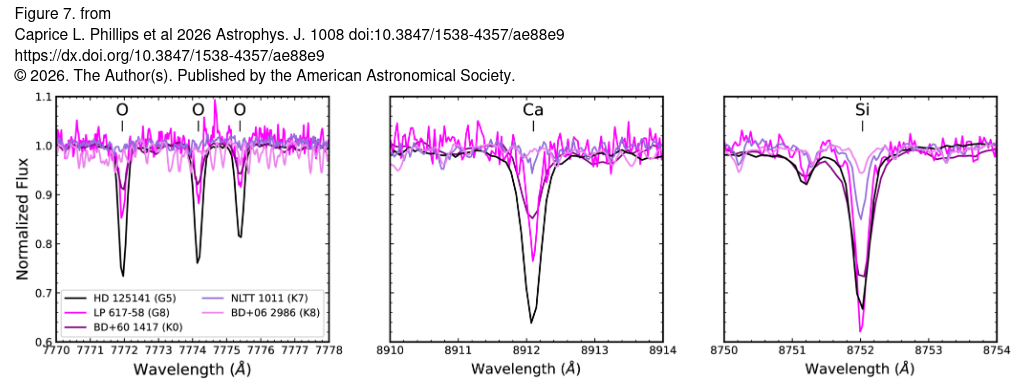
We present results from a spectroscopic survey of 32 FGK stars hosting brown dwarfs, using high-resolution optical spectra (R = 130,000 and 50,000) obtained with the Potsdam Echelle Polarimetric and Spectroscopic Instrument spectrograph on the Large Binocular Telescope. The primary goal of this survey is to determine precise stellar parameters and abundances for 11 elements (C, O, Mg, Si, Ca, Al, Ti, Fe, Y, S, and N) in these systems. We employ spectral synthesis within the BACCHUS framework to derive precise stellar properties and elemental abundance ratios. For our data with average signal-to-noise ratio > 200, we achieve a typical error of 42 K in Teff and ∼0.03 dex for [Fe/H]. We observe a significant dispersion from a solar C/O ratio among the sample of brown dwarf host stars that host primarily wide-orbit brown dwarfs. Using established theoretical chemical frameworks, we discuss the implications of the observed Mg/Si and Ca/Al ratios for cloud properties in the brown dwarf companions. Finally, we evaluate the applicability of the [Y/Mg] stellar clock for our sample and discuss the broader implications of our results. This work provides a timely and uniform abundance analysis of host stars, supporting extended wavelength brown dwarf observations in the era of JWST.
Read more: Phillips et al. 2026, ApJ, 1008, 67