
News
Benchmark Brown Dwarf Systems. I. Chemical Abundance Analysis of FGK Stars with Wide-separation Brown Dwarf Companions Using PEPSI
2026-10-15
We present results from a spectroscopic survey of 32 FGK stars hosting brown dwarfs, using high-resolution optical spectra (R = 130,000 and 50,000) obtained with the Potsdam Echelle Polarimetric and Spectroscopic Instrument spectrograph on the Large Binocular Telescope. The primary goal of this survey is to determine precise stellar parameters and abundances for 11 elements (C, O, Mg, Si, Ca, Al, Ti, Fe, Y, S, and N) in these systems. We employ spectral synthesis within the BACCHUS framework to derive precise stellar properties and elemental abundance ratios. For our data with average signal-to-noise ratio > 200, we achieve a typical error of 42 K in Teff and ∼0.03 dex for [Fe/H]. We observe a significant dispersion from a solar C/O ratio among the sample of brown dwarf host stars that host primarily wide-orbit brown dwarfs. Using established theoretical chemical frameworks, we discuss the implications of the observed Mg/Si and Ca/Al ratios for cloud properties in the brown dwarf companions. Finally, we evaluate the applicability of the [Y/Mg] stellar clock for our sample and discuss the broader implications of our results. This work provides a timely and uniform abundance analysis of host stars, supporting extended wavelength brown dwarf observations in the era of JWST.
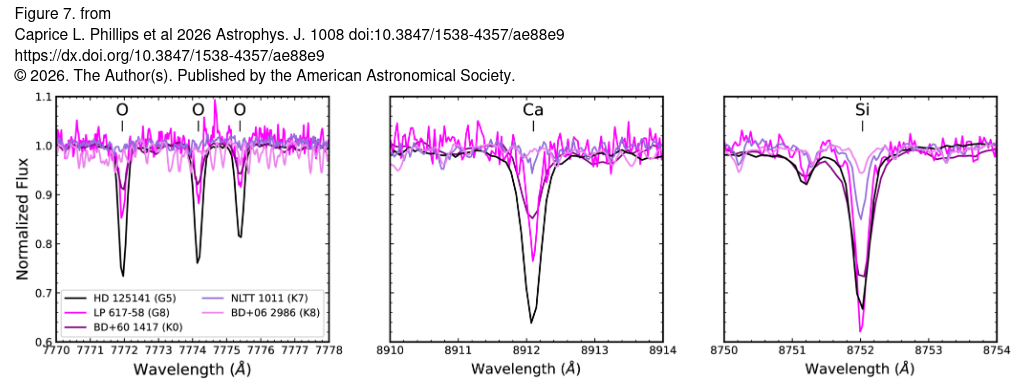
Read more: Phillips et al. 2026, ApJ, 1008, 67
Antisolar Differential Rotation May Have Revived Magnetic Braking in the Subgiant 31 Aquilae
2026-10-14
Recent observations have shown that sufficiently slow rotation disrupts the organization of large-scale magnetic field in older main-sequence stars, leading to weakened magnetic braking (WMB) and a collapse in the efficiency of the global stellar dynamo. Recent simulations predict a shift from solar-like to antisolar differential rotation (DR) at slower rotation rates, which typically do not occur on the main sequence due to WMB. However, physical expansion on the subgiant branch can eventually slow the stellar rotation beyond this threshold, yielding a noncycling large-scale field that revives magnetic braking. We combine asteroseismology from the Transiting Exoplanet Survey Satellite (TESS) with spectropolarimetry from the Large Binocular Telescope (LBT) to test these predictions in the old metal-rich subgiant 31 Aql.

Read more: Metcalfe et al. 2026, AJ, 171, 287
Does the solar oxygen abundance change over the solar cycle?: An investigation into activity-induced variations in the O I infrared triplet
2026-01-24
The determination of the solar oxygen abundance remains a central problem in astrophysics, as its accuracy is limited not only by models but also by systematics. While many of these factors have been thoroughly characterized, the effect of the solar activity cycle has so far remained unexplored. Due to its relative strength and accessibility, the O I infrared triplet is typically the primary choice for abundance studies. However, previous investigations have shown that abundances inferred from this triplet tend to be higher than expected on active stars, whereas such an overabundance effect is not observed for the much weaker forbidden O I 6300 Å line. This raises the question of whether a similar trend can be found for the Sun. To address this question, we analyze two decades’ worth of synoptic disk-integrated Sun-as-a-star datasets from the FEROS, HARPS-N, PEPSI, and NEID spectrographs, focusing on the infrared triplet (7772, 7774, 7775 Å) and the forbidden O I 6300 Å line. The excellent signal-to-noise ratio of the PEPSI observations allows us to detect a weak but significant variation in the equivalent widths of the infrared triplet, corresponding to about 0.01 dex difference in abundance between activity minimum and maximum. This value is significantly smaller than the typical uncertainties on the solar oxygen abundance. Due to higher scatter, no comparable trend is found in the other data sets. Based on these results, we conclude that within the typical uncertainties presented in other works, we can assume the inferred solar oxygen abundance to be stable across the solar cycle, but that this effect may be significant for other, more active stars.

Read more: Pietrow et al. 2026, A&A, 706, L11
Surface image and activity-corrected orbit of the RSCVn binary HR7275: Disentangling activity tracers
2026-01-07
Quantifying stellar parameters and magnetic activity for cool stars in double-lined spectroscopic binaries (SB2) is not straightforward, as both stars contribute to the observed composite spectra and are likely variable. Disentangled component spectra allow a detailed analysis of a component’s magnetic activity. We aim at separating the spectra of the two stellar components of the HR7275 SB2 system. Our further aim is a more accurate orbital solution by cleaning the observed radial velocities (RV) from activity perturbations of the spotted primary (“RV jitter”) and obtain a surface image of this component. We provide time-series high- and ultra-high resolution optical spectra and apply two different disentangling methods. RV residuals are modeled with three-sine function fits. The primary’s spectral-line profiles are modeled with the Doppler imaging code iMAP. Magnetic fields are measured for the primary based on least-square deconvolved Stokes-V line profiles. Chromospheric emission is determined from the line-cores of Ca II H&K, Ca II IRT 8542 Å, and Balmer Hα. Before applying those analyses, we provide a disentangling technique to determine the system properties more accurately. The Doppler image of the primary shows two large cool spots of size ≈20% of the visible hemisphere plus three smaller spots, each still ≈13% in size. In total, HR7275a exhibited an impressive spottedness of ≈40% of its entire surface in May-June 2022. The RV is modulated by the rotation of the primary with maximum amplitudes of 320 ms−1 and 650 ms−1 for two different modulation behaviors during the 250 d of our observations. This jitter is primarily caused by the varying asymmetries of the apparent disk brightness due to the cool spots. Its removal resulted in roughly ten times higher precision of the orbital elements. Our snapshot magnetic-field measurements reveal phase dependent (large-scale) surface fields between +0.6±2.0G at phase 0.1 and −15.2±2.7G at phase 0.6, indicating a complex magnetic morphology related to the location of the photospheric spots. We also obtain a logarithmic lithium abundance of 0.58±0.1 for HR7275a, indicating considerable mixing, and 0.16 for HR7275b, which is an extremely low value.
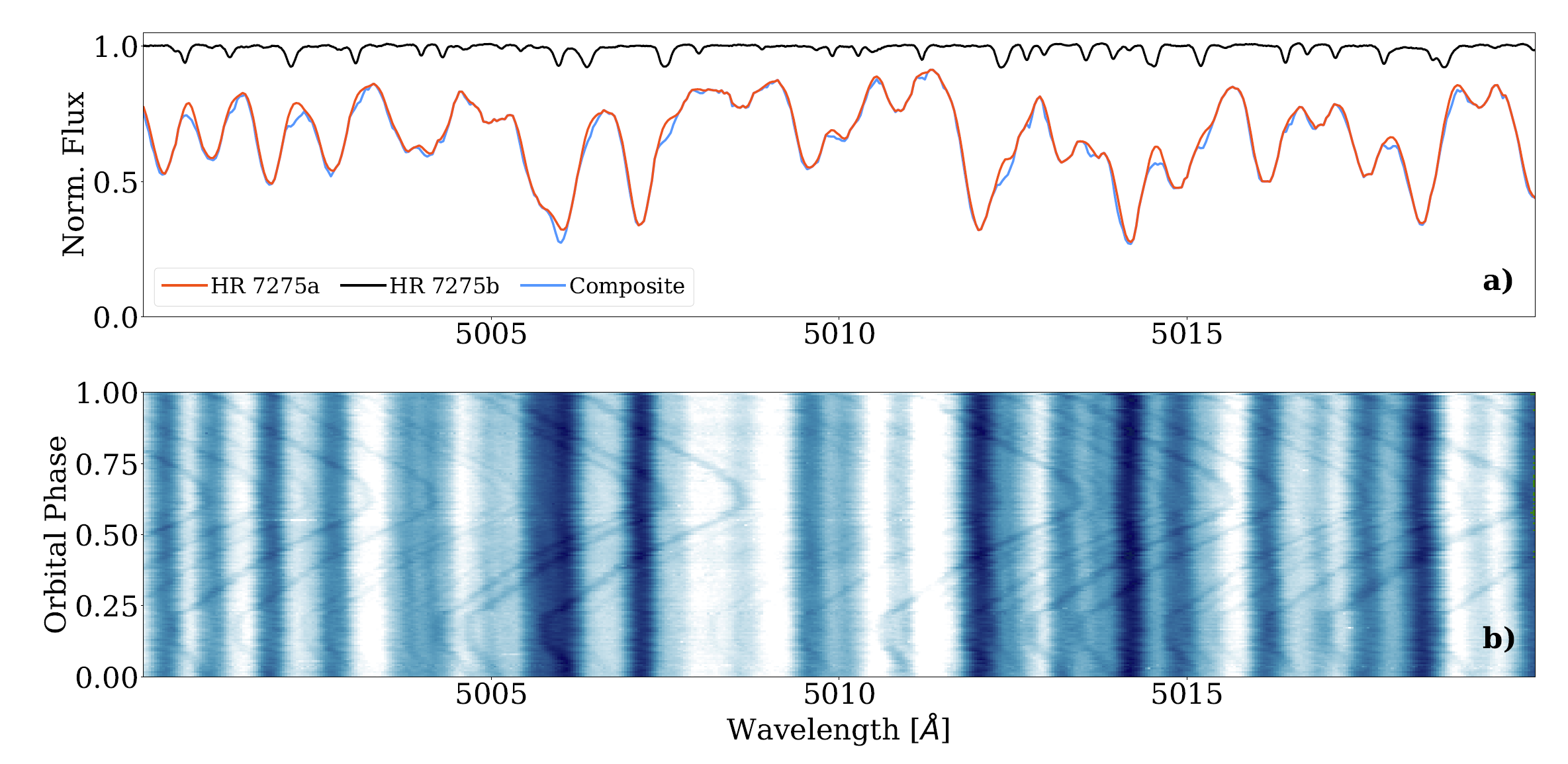
Read more: Adebali et al. 2026, A&A, 706, A179
Untangling the Sources of Abundance Dispersion in Low-metallicity Stars. II. Neutron Capture Elements
2026-01-06
We present the abundances of 23 elements, including 11 heavy elements (Cu, Zn, Sr, Y, Zr, Ba, La, Ce, Nd, Sm, Eu) for up to 86 metal-poor (−2 ≲ [Fe/H] ≲ −1) subgiants. We use KORG, a state of the art spectral synthesis package, to derive 1D-LTE abundances from high-SNR and high-resolution spectra taken by the Large Binocular Telescope with the Potsdam Echelle Polarimetric and Spectroscopic Instrument. These precise spectra and abundance measurements minimize the impact of photon-noise (≲ 0.06 dex), allowing us to robustly measure the intrinsic abundance scatter in [X/Fe]. After removing two stars with exceptional s-process enhancement, we find that the intrinsic scatter among the s- and r-process elements tends to be larger than for the lighter elements, with heavy element scatter ranging from 0.11 (Zn) to 0.27 (Eu) dex. Intrinsic abundance scatter could have multiple origins, including starto-star variations in the ratios of nucleosynthetic sources as well as stochastic sampling of the progenitor supernovae properties, such as mass, rotation, and magnetic field strength. We explore the expected abundance scatter signature caused by stochastic sampling, finding that a fraction of both rapidly rotating CCSN and magnetorotationally driven SN are needed to reach the observed abundances and intrinsic scatter. This analysis is limited by the restrictive parameter spaces spanned by existing yield sets. A diverse, finely sampled grid of supernovae yields is needed to robustly model stochastic abundance scatter.
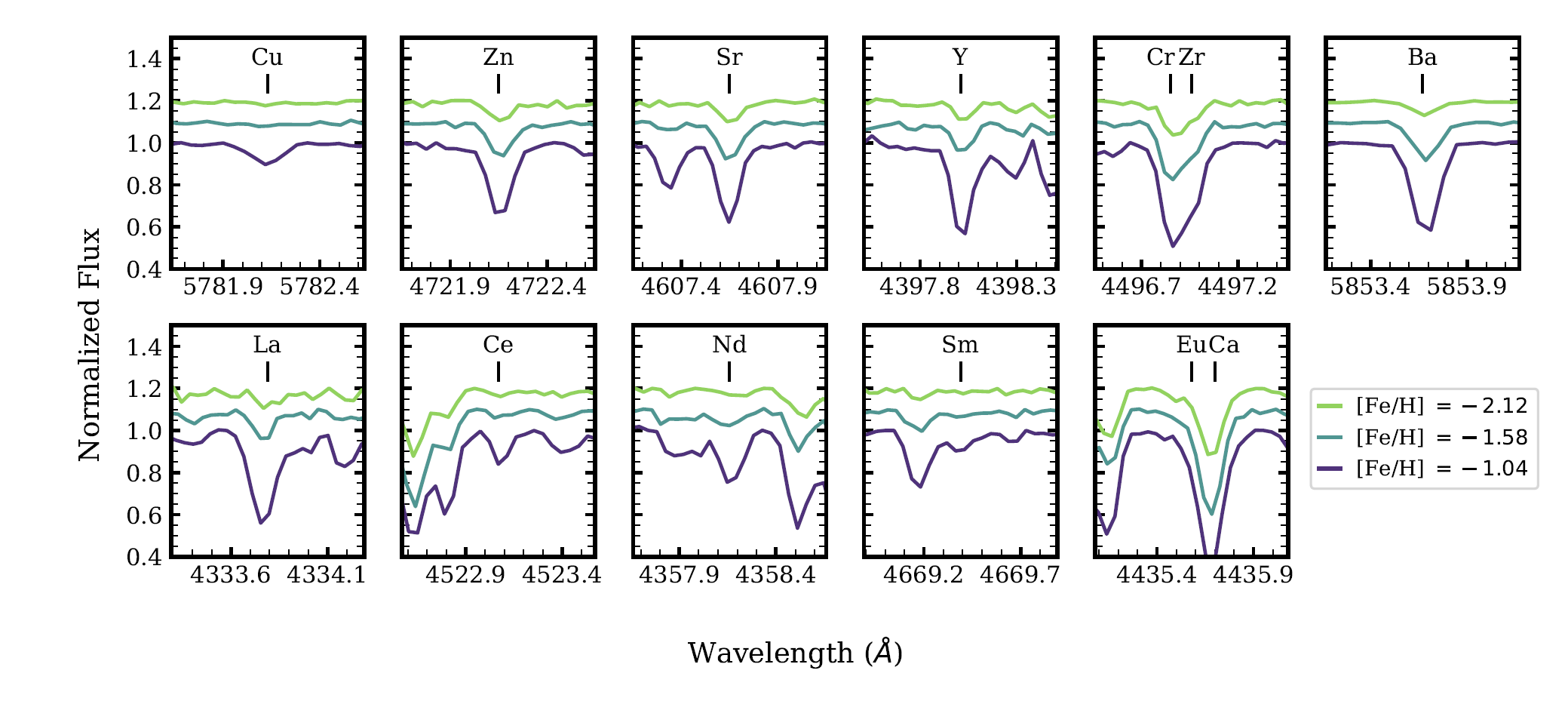
Read more: Griffith et al. 2026, ApJ, 1001, 193