
News
Nodal Precession and Tidal Evolution of Two Hot-Jupiters:WASP-33 b and KELT-9 b
2022-04-05
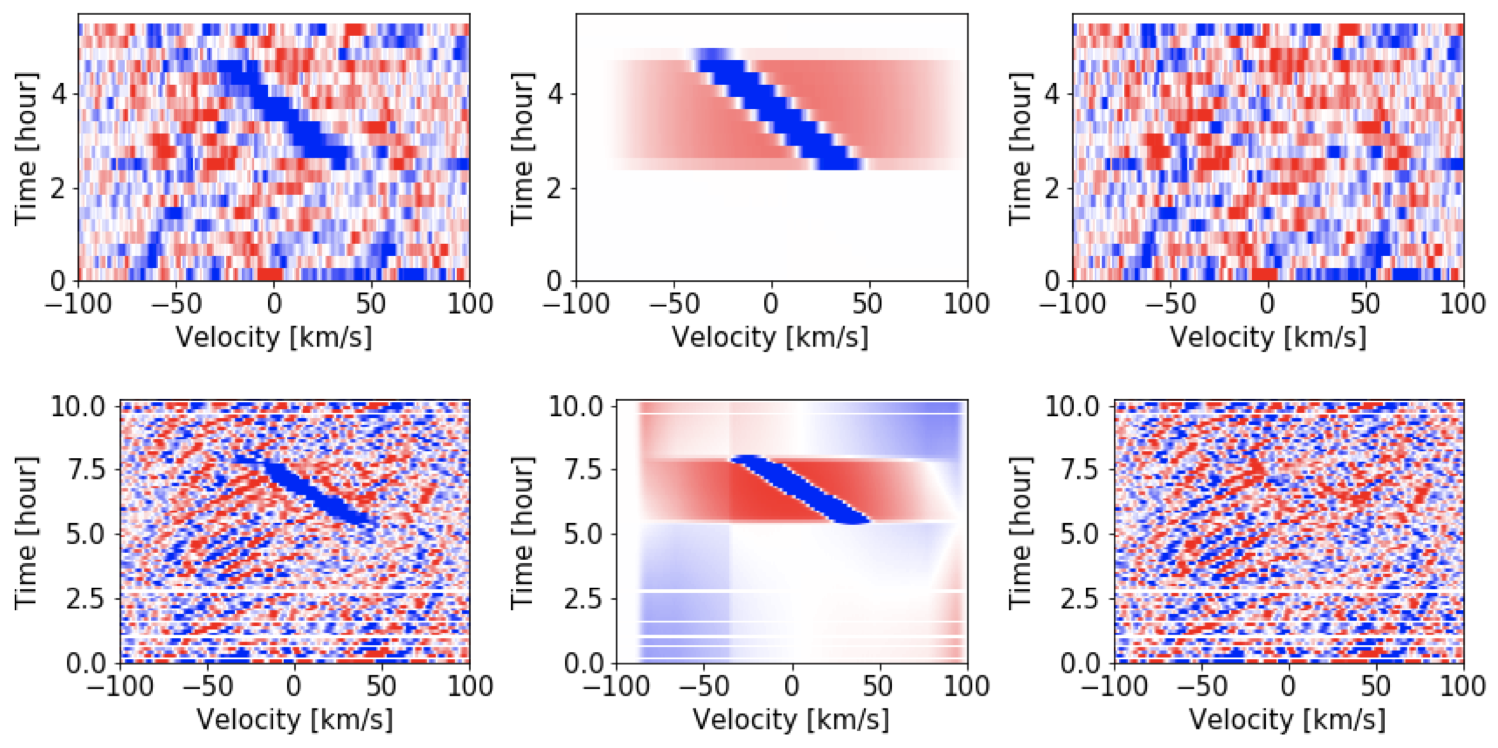
Hot Jupiters orbiting rapidly rotating stars on inclined orbits undergo tidally induced nodal precession measurable over several years of observations. The Hot Jupiters WASP-33 b and KELT-9 b are particularly interesting targets as they are among the hottest planets found to date, orbiting relatively massive stars. Here, we analyze archival and new data that span 11 and 5 years for WASP-33 b and KELT-9 b, respectively, in order to to model and improve upon their tidal precession parameters. Our work confirms the nodal precession for WASP-33 b and presents the first clear detection of the precession of KELT-9 b. We determine that WASP-33 and KELT-9 have gravitational quadrupole moments. We estimate the planets' precession periods to be 1460 years and 890 years, respectively, and that they will cease to transit their host stars around the years 2090CE and 2074CE, respectively. Additionally, we investigate both planets' tidal and orbital evolution, suggesting that a high-eccentricity tidal migration scenario is possible to produce both system architectures and that they will most likely not be engulfed by their hosts before the end of their main sequence lifetimes.
Read more: Stephan et al. 2022, ApJ, 931, 111
The PEPSI exoplanet transit survey (PETS) I: Investigating the presence of a silicate atmosphere on the super-earth 55 Cnc e
2022-04-05
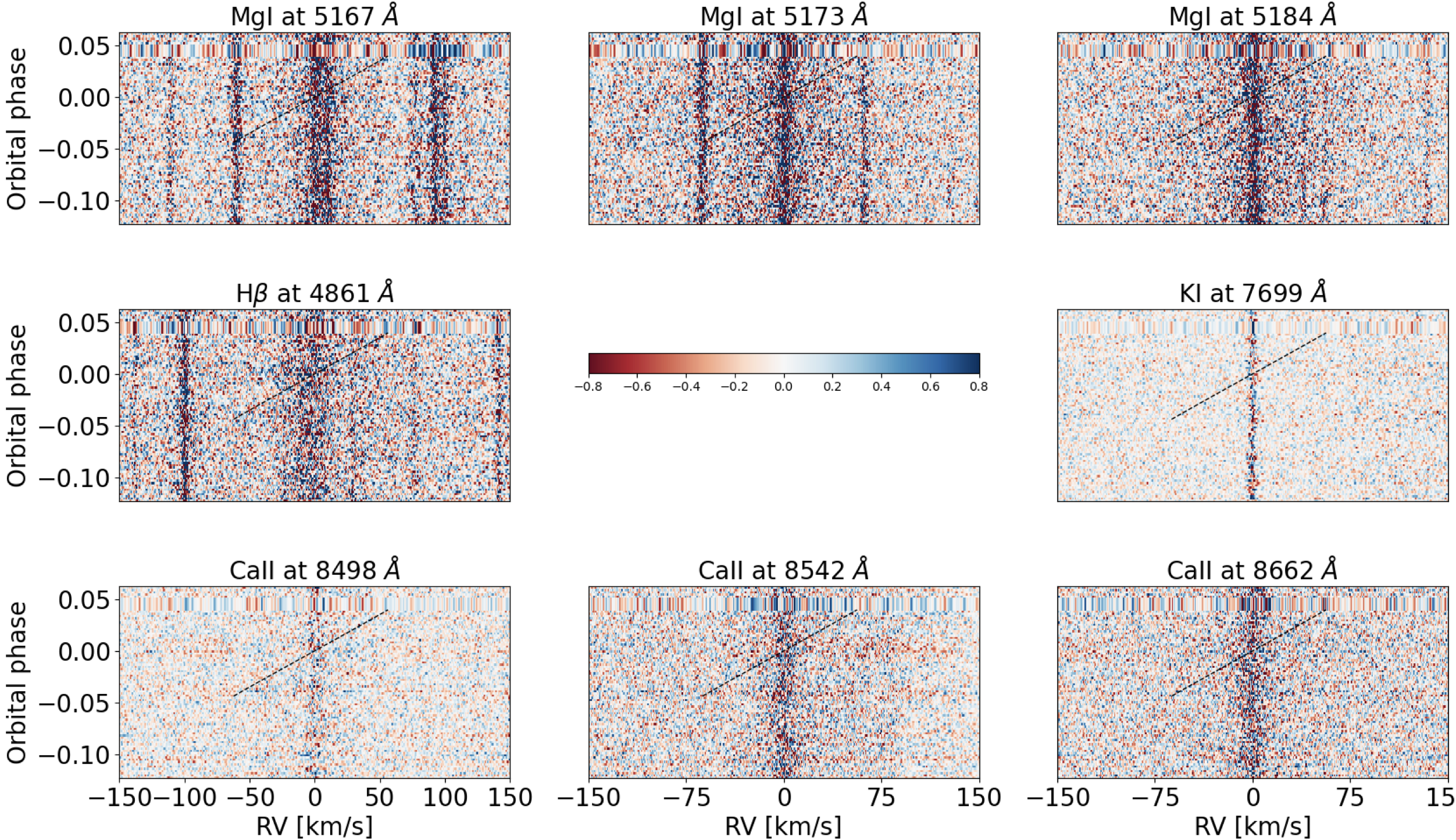
The study of exoplanets and especially their atmospheres can reveal key insights on their evolution by identifying specific atmospheric species. For such atmospheric investigations, high-resolution transmission spectroscopy has shown great success, especially for Jupiter-type planets. Towards the atmospheric characterization of smaller planets, the super-Earth exoplanet 55 Cnc e is one of the most promising terrestrial exoplanets studied to date. Here, we present a high-resolution spectroscopic transit observation of this planet, acquired with the PEPSI instrument at the Large Binocular Telescope. Assuming the presence of Earth-like crust species on the surface of 55 Cnc e, from which a possible silicate-vapor atmosphere could have originated, we search in its transmission spectrum for absorption of various atomic and ionized species such as Fe , Fe +, Ca , Ca +, Mg and K , among others. Not finding absorption for any of the investigated species, we are able to set absorption limits with a median value of 1.9 × RP. In conclusion, we do not find evidence of a widely extended silicate envelope on this super-Earth reaching several planetary radii.
Read more: Keles et al. 2022, MNRAS, 513, 1544
Variable and Supersonic Winds in the Atmosphere of an Ultrahot Giant Planet
2022-04-05
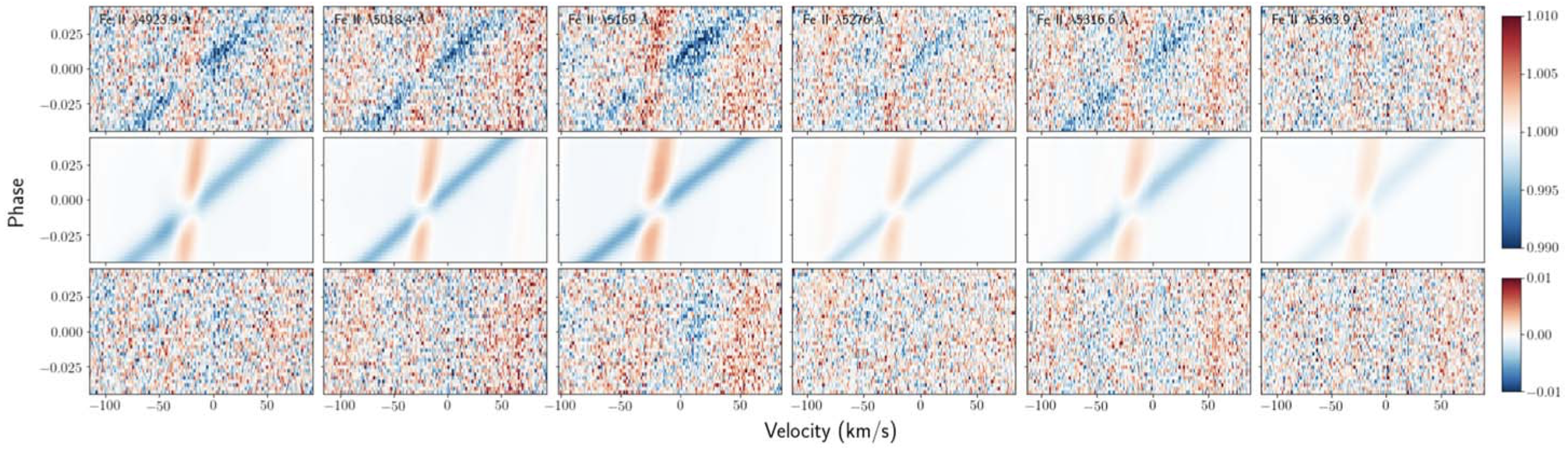
Hot Jupiters receive intense irradiation from their stellar hosts. The resulting extreme environments in their atmospheres allow us to study the conditions that drive planetary atmospheric dynamics, e.g., global-scale winds. General circulation models predict day-to-nightside winds and equatorial jets with speeds of the order of a few km s-1. To test these models, we apply high-resolution transmission spectroscopy using the Potsdam Echelle Polarimetric and Spectroscopic Instrument (PEPSI) spectrograph on the Large Binocular Telescope to study the atmosphere of KELT-9 b, an ultrahot Jupiter and currently the hottest known planet. We measure ~10 km s-1 day-to-nightside winds traced by Fe II features in the planet's atmosphere. This is at odds with previous literature (including data taken with PEPSI), which report no significant day-to-nightside winds on KELT-9 b. We identify the cause of this discrepancy as due to an inaccurate ephemeris for KELT-9 b in previous literature.
Read more: Pai Asnodkar et al. 2022, AJ, 163, 155
KELT-9 as an Eclipsing Double-lined Spectroscopic Binary: A Unique and Self-consistent Solution to the System
2022-01-17
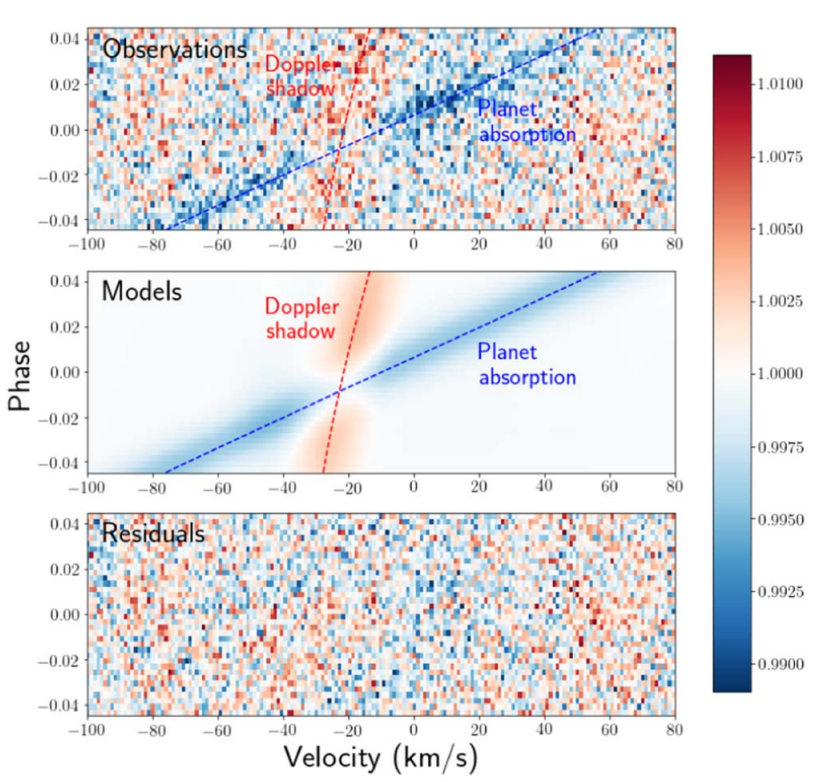
Transiting hot Jupiters present a unique opportunity to measure absolute planetary masses due to the magnitude of their radial velocity signals and known orbital inclination. Measuring planet mass is critical to understanding atmospheric dynamics and escape under extreme stellar irradiation. Here we present the ultrahot Jupiter system KELT-9 as a double-lined spectroscopic binary. This allows us to directly and empirically constrain the mass of the star and its planetary companion without reference to any theoretical stellar evolutionary models or empirical stellar scaling relations. Using data from the PEPSI, HARPS-N, and TRES spectrographs across multiple epochs, we apply least-squares deconvolution to measure out-of-transit stellar radial velocities. With the PEPSI and HARPS-N data sets, we measure in-transit planet radial velocities using transmission spectroscopy. By fitting the circular orbital solution that captures these Keplerian motions, we recover a planetary dynamical mass of 2.17 ± 0.56 MJ and stellar dynamical mass of 2.11 ± 0.78 M⊙, both of which agree with the discovery paper. Furthermore, we argue that this system, as well as systems like it, are highly overconstrained, providing multiple independent avenues for empirically cross-validating model-independent solutions to the system parameters. We also discuss the implications of this revised mass for studies of atmospheric escape.
Read more: Pai Asnodkar et al. 2022, AJ, 163, 40
Extremely slowly rotating magnetic O9.7V star HD54879
2022-01-07
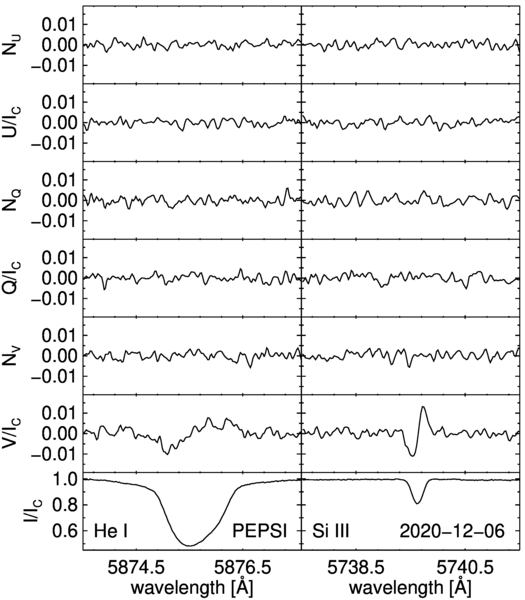
The O9.7 V star HD 54879 is currently the only massive magnetic star whose magnetic field geometry and rotation period are not constrained. Over the last three years, we gathered additional observations of this star, obtained using various instruments at several astronomical facilities with, the aim to constrain the rotation period and the magnetic field geometry. The new data include the first full Stokes vector observations with the PEPSI spectropolarimeter, installed at the Large Binocular Telescope. The acquired spectropolarimetric observations show a very slow magnetic field variability related to the extremely slow rotation of HD 54879, which is also indicated in a dynamical spectrum, displaying variability of the Hα line.
Generally, magnetic massive O- and B-type stars exhibit a smooth, single-wave variation of the longitudinal magnetic field during the stellar rotation cycle. The approximately sinusoidal variation of ⟨Bz⟩ and the ratio of the values of the ⟨Bz⟩ extrema in previously studied stars suggest that there is an important component of the field that is dipolar. Assuming that the magnetic field of HD 54879 has a pure dipolar configuration and that the negative field extremum is indeed around −570 G and not at a lower value, we fitted a cosine curve to the observed distribution of data points obtained from the high-resolution spectropolarimetric observations and determined a stellar rotation period of 7.2 yr. Certainly, further monitoring of the magnetic field variability is needed to determine the rotation period with more confidence. We note, that magnetic studies of several O-type stars indicate that only one magnetic pole is well visible while the star rotates, implying that the magnetic field structure over the fraction of their invisible surface remains unconstrained.
Read more: Järvinen et al. 2022, MNRAS, 501, 4405