
News
Solar disk integration polarimeter: An automateddisk-integration full-Stokes-vector solar feed for thePEPSI spectrograph
2024-07-01
We introduce a new solar feed for the PEPSI nighttime spectrograph of the LBT. It enables spectroscopy of the Sun-as-a-star in circular polarization (CP) and linear polarization (LP) with a spectral resolution of 250,000 (≈0.025 Å or 600 m s−1) for the wavelength range 383–907 nm. The polarimeter is a dual-beam design with a modified Wollaston prism as beam splitter and linear polarizer combined with a retractable super-achromatic 𝜆∕4 retarder. The Wollaston beam diameter is 14 mm and large enough that it does not require a classical telescopic feed anymore. Both polarimetric beams are re-imaged into respective integration spheres from which two fibers feed the scrambled light to the spectrograph. The system is fully automated in the sense that it finds the Sun in the morning, closes the guider loop, observes a predefined number of individual spectra, and moves to a home position at the end of the day. Among the scientific aims is Zeeman–Doppler imaging of the Sun as a star over the next activity cycle. Our first-light application detects a clear Stokes-V/I profile with a full amplitude of 1 × 10⁻⁴ on, for example, October 13, 2023, suggesting a solar disk-averaged line-of-sight net magnetic field of +0.37±0.02 G. Comparison of this value with a contemporary full-disk line-of-sight magnetogram suggests an unsigned mean field of about ≈13 G.
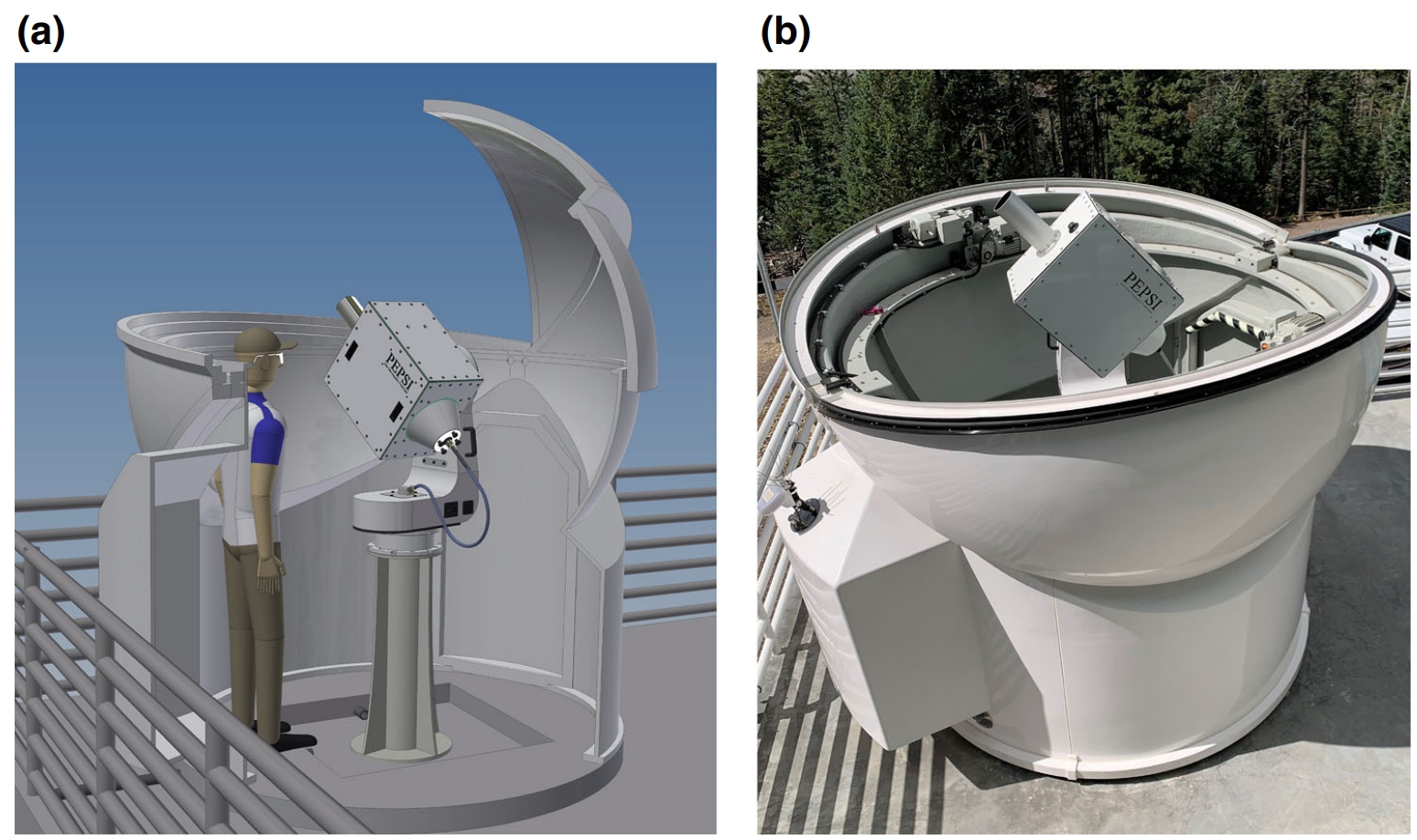
Read more: Strassmeier et al. 2024, AN, 345, e240033
Exploring the directly imaged HD1160 system through spectroscopic characterization and high-cadence variability monitoring
2024-06-10
The time variability and spectra of directly imaged companions provide insight into their physical properties and atmospheric dynamics. We find an effective temperature Teff = 2794+115−133 K on the first night, consistent with the literature, but a cooler Teff = 2279+79−157 K on the next. We estimate the mass of HD 1160 B to be 16-81 MJup, depending on its age. We also present R = 50 000 high-resolution optical spectroscopy of host star HD 1160 A obtained simultaneously with the PEPSI spectrograph. We reclassify its spectral type to A1 IV-V and measure its projected rotational velocity vsini = 96+6−4 km s-1. We thus highlight that gvAPP-enabled differential spectrophotometry can achieve repeatable few per cent level precision and does not yet reach a systematic noise floor, suggesting greater precision is achievable with additional data or advanced detrending techniques.
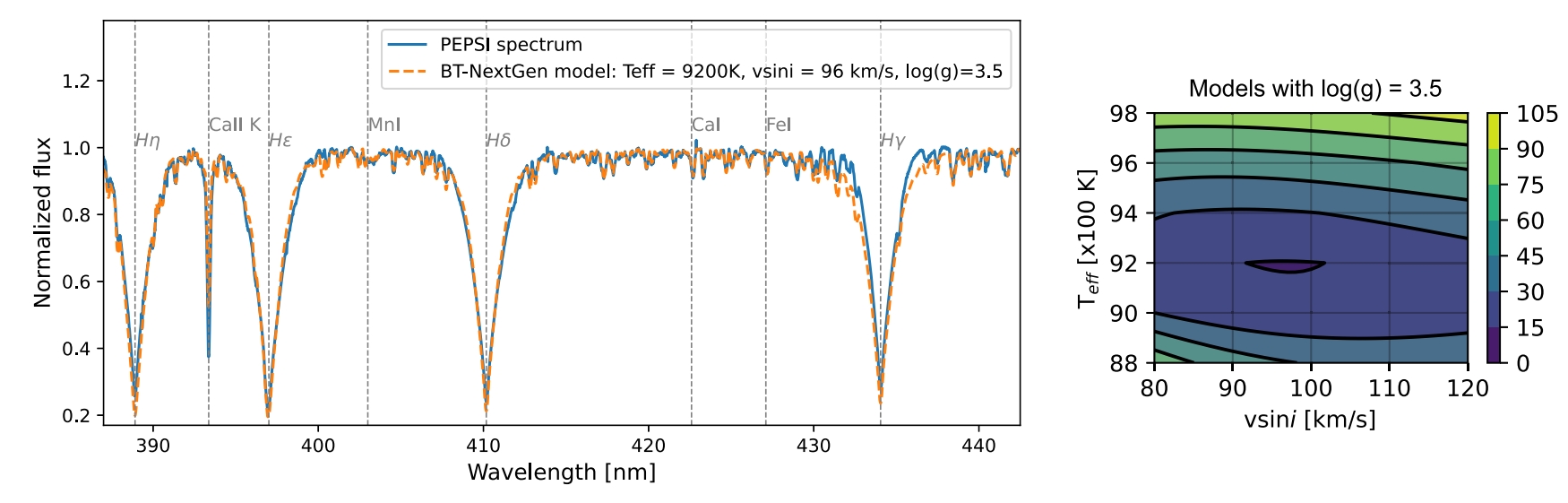
Read more: Sutlieff et al. 2024, MNRAS, 531, 2168
The PEPSI Exoplanet Transit Survey (PETS) - V. New Na D transmission spectra indicate a quieter atmosphere on HD 189733b
2024-06-03
Absorption lines from exoplanet atmospheres observed in transmission allow us to study atmospheric characteristics such as winds. We present a new high-resolution transit time-series of HD 189733b, acquired with the PEPSI instrument at the LBT and analyse the transmission spectrum around the Na D lines. We model the spectral signature of the RM-CLV-effect using synthetic PHOENIX spectra based on spherical LTE atmospheric models. We find an Na D absorption signature between the second and third contact but not during the ingress and egress phases, which casts doubt on the planetary origin of the signal. Presupposing a planetary origin of the signal, the results suggest a weak day-to-nightside streaming wind in the order of 0.7 km/s and a moderate super-rotational streaming wind in the order of 3-4 km/s, challenging claims of prevailing strong winds on HD 189733b.
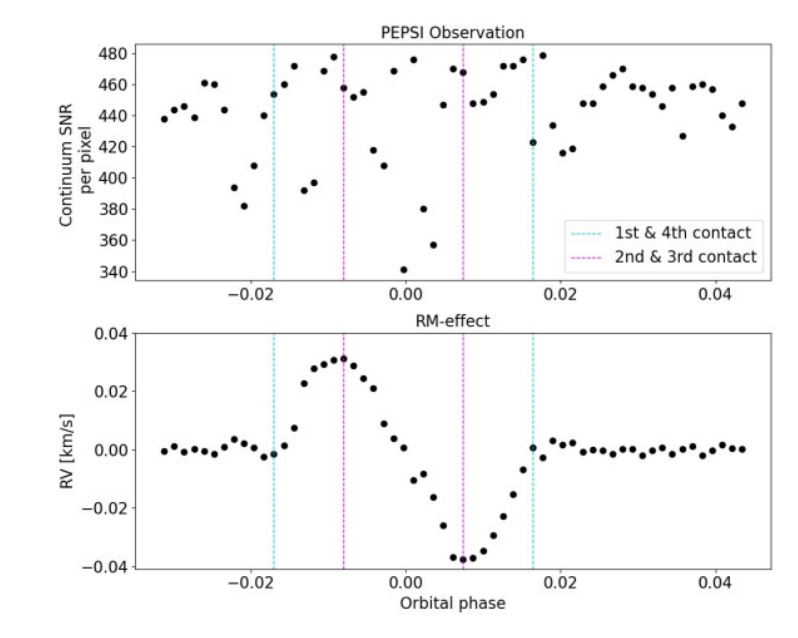
Read more: Keles et al. 2024, MNRAS, 530, 4826
Testing pulsation diagnostics in the rapidly oscillating magnetic Ap star gamma Equ
2024-03-04
Pulsations of rapidly oscillating Ap stars and their interaction with the stellar magnetic field have not been studied in the near-infrared (near-IR) region despite the benefits these observations offer compared to visual wavelengths. The main advantage of the near-IR is the quadratic dependence of the Zeeman effect on the wavelength, as opposed to the linear dependence of the Doppler effect.
To test pulsation diagnostics of roAp stars in the near-IR, we investigated the pulsation behaviour of one of the brightest magnetic roAp stars, γ Equ, which possesses a strong surface magnetic field of the order of several kilogauss and exhibits magnetically split spectral lines in its spectra.
The profile shapes of both studied magnetically split spectral lines in H-band vary in a rather complex manner probably due to a significant decrease in the strength of the longitudinal field component and an increase in the strength of the transverse field components over the last decade. A mean magnetic field modulus of 3.9 kG was determined for the Zeeman triplet Fe I at 1563.63 nm, whereas for the pseudo- doublet Ce III at 1629.2 nm we observe a much lower value of only about 2.9 kG. For comparison, a mean field modulus of 3.4 kG was determined using the Zeeman doublet Fe II at 6249.25 Å in optical PEPSI spectra recorded just about two weeks before the 2022 CRIRES+ observations. Different effects may lead to the differences in the field modulus values. The measurements of the mean magnetic field modulus in different pulsational phase bins suggest a field modulus variability of 32 G for the Zeeman triplet Fe I and 102 G for the pseudo-doublet Ce III.
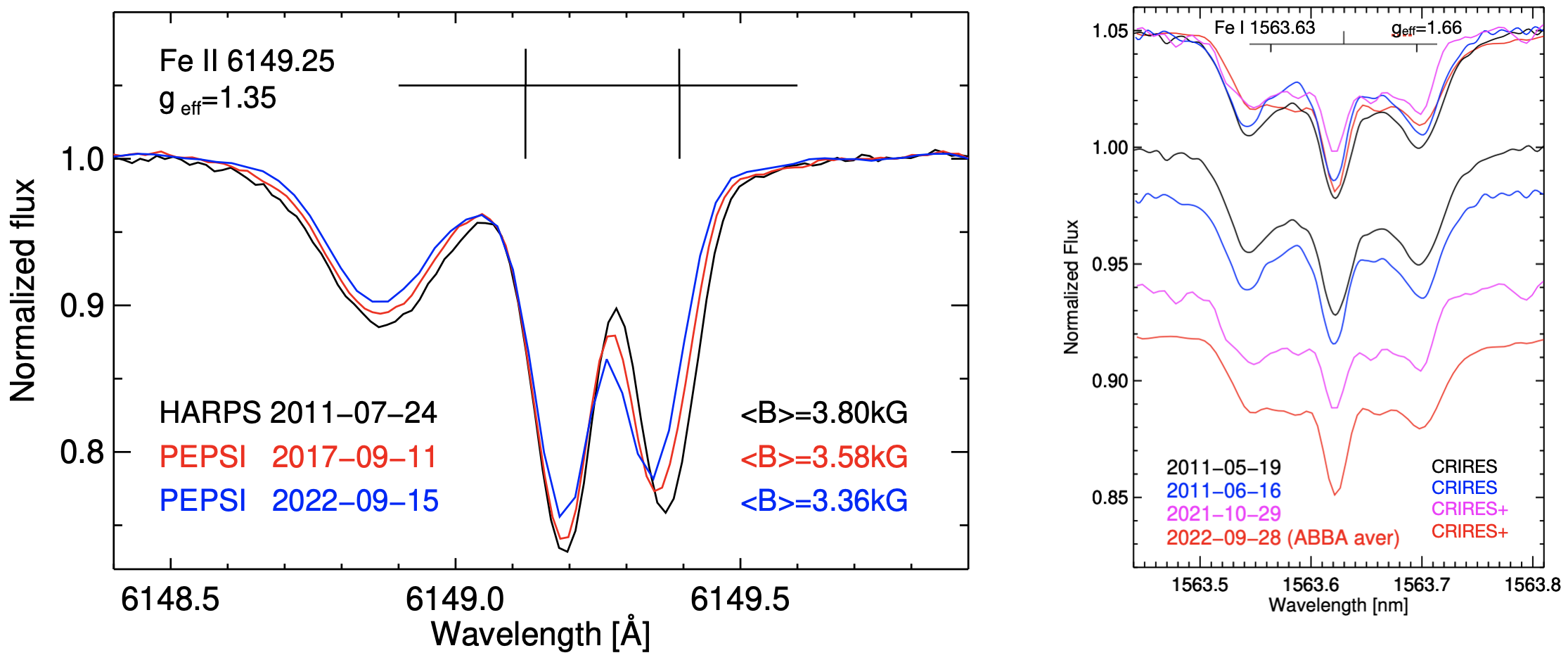
Read more: Järvinen et al. 2024, A&A, 683, A66
Weakened Magnetic Braking in the Exoplanet Host Star 51 Peg
2024-01-12
The consistently low activity level of the old solar analog 51 Peg not only facilitated the discovery of the first hot Jupiter, but also led to the suggestion that the star could be experiencing a magnetic grand minimum. However, the 50 yr time series showing minimal chromospheric variability could also be associated with the onset of weakened magnetic braking (WMB), where sufficiently slow rotation disrupts cycling activity and the production of large scale magnetic fields by the stellar dynamo, thereby shrinking the Alfvén radius and inhibiting the efficient loss of angular momentum to magnetized stellar winds. In this Letter, we evaluate the magnetic evolutionary state of 51 Peg by estimating its wind braking torque. We use new spectropolarimetric measurements from the Large Binocular Telescope to reconstruct the large-scale magnetic morphology, we reanalyze archival X-ray measurements to estimate the mass-loss rate, and we detect solar-like oscillations in photometry from the Transiting Exoplanet Survey Satellite, yielding precise stellar properties from asteroseismology. Our estimate of the wind braking torque for 51 Peg clearly places it in the WMB regime, driven by changes in the mass-loss rate and the magnetic field strength and morphology that substantially exceed theoretical expectations. Although our revised stellar properties have minimal consequences for the characterization of the exoplanet, they have interesting implications for the current space weather environment of the system.
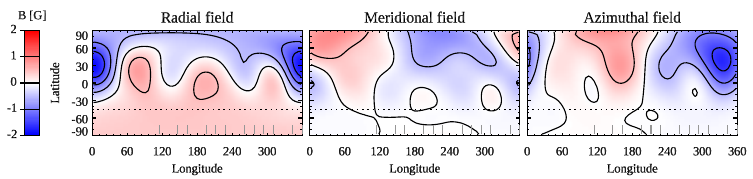
Read more: Metcalfe et al. 2024, ApJ, 960, L6