
News
Spectrum poster of Mu Leonis
2018-05-18
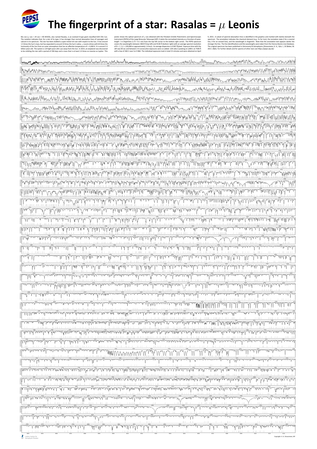
The poster shows the optical spectrum of Mu Leonis obtained with the Potsdam Echelle Polarimetric and Spectroscopic Instrument (PEPSI) of the Large Binocular Telescope (LBT).
Spectrum poster of Sirius
2018-05-18
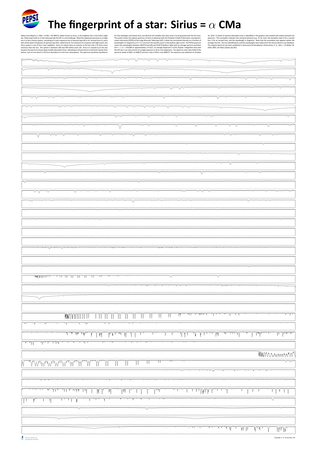
The poster shows the optical spectrum of Sirius obtained with the Potsdam Echelle Polarimetric and Spectroscopic Instrument (PEPSI) of the Large Binocular Telescope (LBT).
PEPSI deep spectra. III. Chemical analysis of the ancient planet-host star Kepler-444
2018-04-07
Context. With the Large Binocular Telescope (LBT), we obtained a spectrum with PEPSI, its new optical high-resolution échelle spectrograph. The spectrum has very high resolution and a high signal-to-noise (S/N) and is of the K0V host Kepler-444, which is known to host five sub-Earth-sized rocky planets. The spectrum has a resolution of R ≈ 250 000, a continuous wavelength coverage from 4230 Å to 9120 Å, and an S/N between 150-550:1 (blue to red). Aim. We performed a detailed chemical analysis to determine the photospheric abundances of 18 chemical elements. These were used to place constraints on the bulk composition of the five rocky planets.
Methods: Our spectral analysis employs the equivalent-width method for most of our spectral lines, but we used spectral synthesis to fit a small number of lines that required special care. In both cases, we derived our abundances using the MOOG spectral analysis package and Kurucz model atmospheres.
Results: We find no correlation between elemental abundance and condensation temperature among the refractory elements (TC > 950 K). In addition, using our spectroscopic stellar parameters and isochrone fitting, we find an age of 10 ± 1.5 Gyr, which is consistent with the asteroseismic age of 11 ± 1 Gyr. Finally, from the photospheric abundances of Mg, Si, and Fe, we estimate that the typical Fe-core mass fraction for the rocky planets in the Kepler-444 system is approximately 24%.
Conclusions: If our estimate of the Fe-core mass fraction is confirmed by more detailed modeling of the disk chemistry and simulations of planet formation and evolution in the Kepler-444 system, then this would suggest that rocky planets in more metal-poor and α-enhanced systems may tend to be less dense than their counterparts of comparable size in more metal-rich systems.
Read more: Mack et al. 2018, A&A, 612, A46
PEPSI deep spectra. II. Gaia benchmark stars and other M-K standards
2018-04-06
Context. High-resolution échelle spectra confine many essential stellar parameters once the data reach a quality appropriate to constrain the various physical processes that form these spectra. Aim. We provide a homogeneous library of high-resolution, high-S/N spectra for 48 bright AFGKM stars, some of them approaching the quality of solar-flux spectra. Our sample includes the northern Gaia benchmark stars, some solar analogs, and some other bright Morgan-Keenan (M-K) spectral standards.
Methods: Well-exposed deep spectra were created by average-combining individual exposures. The data-reduction process relies on adaptive selection of parameters by using statistical inference and robust estimators. We employed spectrum synthesis techniques and statistics tools in order to characterize the spectra and give a first quick look at some of the science cases possible.
Results: With an average spectral resolution of R ≈ 220 000 (1.36 km s-1), a continuous wavelength coverage from 383 nm to 912 nm, and S/N of between 70:1 for the faintest star in the extreme blue and 6000:1 for the brightest star in the red, these spectra are now made public for further data mining and analysis. Preliminary results include new stellar parameters for 70 Vir and α Tau, the detection of the rare-earth element dysprosium and the heavy elements uranium, thorium and neodymium in several RGB stars, and the use of the 12C to 13C isotope ratio for age-related determinations. We also found Arcturus to exhibit few-percent Ca II H&K and Hα residual profile changes with respect to the KPNO atlas taken in 1999.
PEPSI deep spectra. I. The Sun-as-a-star
2018-04-05
Context. Full-disk solar flux spectra can be directly compared to stellar spectra and thereby serve as our most important reference source for, for example stellar chemical abundances, magnetic activity phenomena, radial-velocity signatures or global pulsations. Aim. As part of the first Potsdam Echelle Polarimetric and Spectroscopic Instrument (PEPSI) key-science project, we aim to provide well-exposed and average-combined (viz. deep) high-resolution spectra of representative stellar targets. Such deep spectra contain an overwhelming amount of information, typically much more than what could be analyzed and discussed within a single publication. Therefore, these spectra will be made available in form of (electronic) atlases. The first star in this series of papers is our Sun. It also acts as a system-performance cornerstone.
Methods: The Sun was monitored with PEPSI at the Large Binocular Telescope (LBT). Instead of the LBT we used a small robotic solar disk integration (SDI) telescope. The deep spectra in this paper are the results of combining up to ≈100 consecutive exposures per wavelength setting and are compared with other solar flux atlases.
Results: Our software for the optimal data extraction and reduction of PEPSI spectra is described and verified with the solar data. Three deep solar flux spectra with a spectral resolution of up to 270 000, a continuous wavelength coverage from 383 nm to 914 nm, and a photon signal to noise ratio (S/N) of between 2000-8000:1 depending on wavelength are presented. Additionally, a time-series of 996 high-cadence spectra in one cross disperser is used to search for intrinsic solar modulations. The wavelength calibration based on Th-Ar exposures and simultaneous Fabry-Pérot combs enables an absolute wavelength solution within 10 m s-1 (rms) with respect to the HARPS laser-comb solar atlas and a relative rms of 1.2 m s-1 for one day. For science demonstration, we redetermined the disk-average solar Li abundance to 1.09 ± 0.04 dex on the basis of 3D NLTE model atmospheres. We detected disk-averaged p-mode RV oscillations with a full amplitude of 47 cm s-1 at 5.5 min.
Conclusions: Comparisons with two solar FTS atlases, as well as with the HARPS solar atlas, validate the PEPSI data product. Now, PEPSI/SDI solar-flux spectra are being taken with a sampling of one deep spectrum per day, and are supposed to continue a full magnetic cycle of the Sun.
Read more: Strassmeier, Ilyin, & Steffen 2018, A&A, 612, A44