
News
The rapidly oscillating Ap star γ Equ: linear polarization as an enhanced pulsation diagnostic?
2021-08-26
We present the first short time scale observations of the roAp star γ Equ in linear polarized light obtained with the PEPSI polarimeter installed at the LBT. These observations are used to search for pulsation variability in Stokes Q and U line profiles belonging to different elements. The atmospheres of roAp stars are significantly stratified with spectral lines of different elements probing different atmospheric depths. roAp stars with strong magnetic fields, such as γ Equ with a magnetic field modulus of 4 kG and a pulsation period of 12.21 min, are of special interest because the effect of the magnetic field on the structure of their atmospheres can be studied with greatest detail and accuracy. Our results show that we may detect changes in the transversal field component in Fe I and rare-earth lines possessing large second-order Landé factors. Such variability can be due to the impact of pulsation on the transverse magnetic field, causing changes in the obliquity angles of the magnetic force lines. Further studies of roAp stars in linear polarized light and subsequent detailed modelling are necessary to improve our understanding of the involved physics.
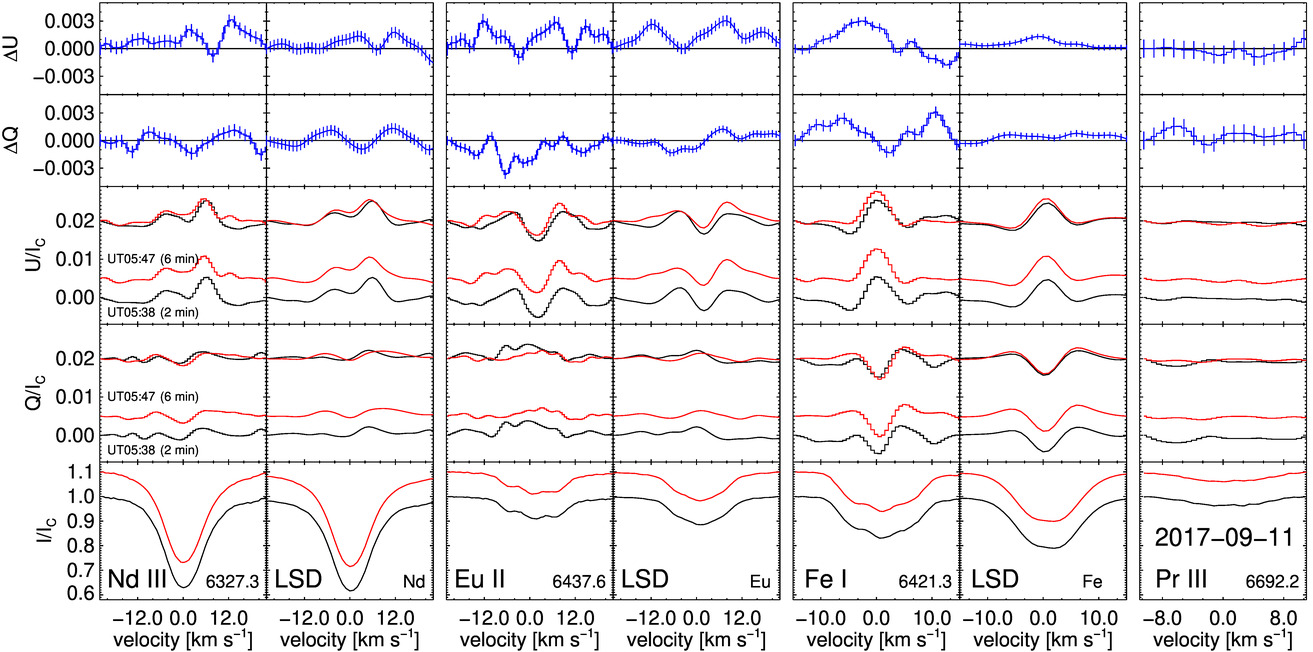
Read more: Hubrig et al. 2021, MNRAS 508 L17
Searching For Transiting Planets Around Halo Stars. I. Sample Selection and Validation
2021-07-07
By measuring the elemental abundances of a star, we can gain insight into the composition of its initial gas cloud -- the formation site of the star and its planets. Planet formation requires metals, the availability of which is determined by the elemental abundance. In the case where metals are extremely deficient, planet formation can be stifled. To investigate such a scenario requires a large sample of metal-poor stars and a search for planets therein. This paper focuses on the selection and validation of a halo star sample. We select ~17,000 metal-poor halo stars based on their Galactic kinematics, and confirm their low metallicities ([Fe/H] < -0.5), using spectroscopy from the literature. Furthermore, we perform high-resolution spectroscopic observations using LBT/PEPSI and conduct detailed metallicity ([Fe/H]) analyses on a sample of 13 previously known halo stars that also have hot kinematics. We can use the halo star sample presented here to measure the frequency of planets and to test planet formation in extremely metal-poor environments.
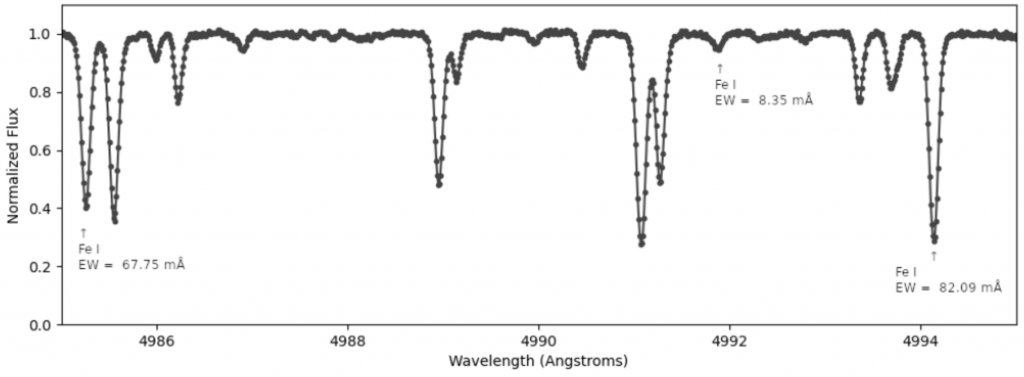
Read more: Kolecki et al. 2021, AJ, 162, 125
Time-resolved rotational velocities in the upper atmosphere of WASP-33 b
2021-02-08
While steady empirical progress has been made in understanding the structure and composition of hot planet atmospheres, direct measurements of velocity signatures, including winds, rotation, and jets, have lagged behind. Quantifying atmospheric dynamics of hot planets is critical to a complete understanding of their atmospheres and such measurements may even illuminate other planetary properties, such as magnetic field strengths. In this manuscript, we present the first detection of the Balmer lines H-alpha and H-beta in the atmosphere of the ultra-hot Jupiter WASP-33b. Using atmospheric models which include the effects of atmospheric dynamics, we show that the shape of the average Balmer line transmission spectrum is consistent with rotational velocities in the planet's thermosphere of vrot = 10.1 (+0.8 -1.0) km/s. We also measure a low-significance day-to-night side velocity shift of -4.6 +/-3.4 km/s in the transmission spectrum which is naturally explained by a global wind across the planet's terminator. In a separate analysis the time-resolved velocity centroids of individual transmission spectra show unambiguous evidence of rotation, with a best-fit velocity of 10.0 (+2.4 -2.0) km/s, consistent with the value of vrot derived from the shape of the average Balmer line transmission spectrum. Our observations and analysis confirm the power of high signal-to-noise, time resolved transmission spectra to measure the velocity structures in exoplanet atmospheres. The large rotational and wind velocities we measure highlight the need for more detailed 3D global climate simulations of the rareed upper-atmospheres of ultra-hot gas giants.
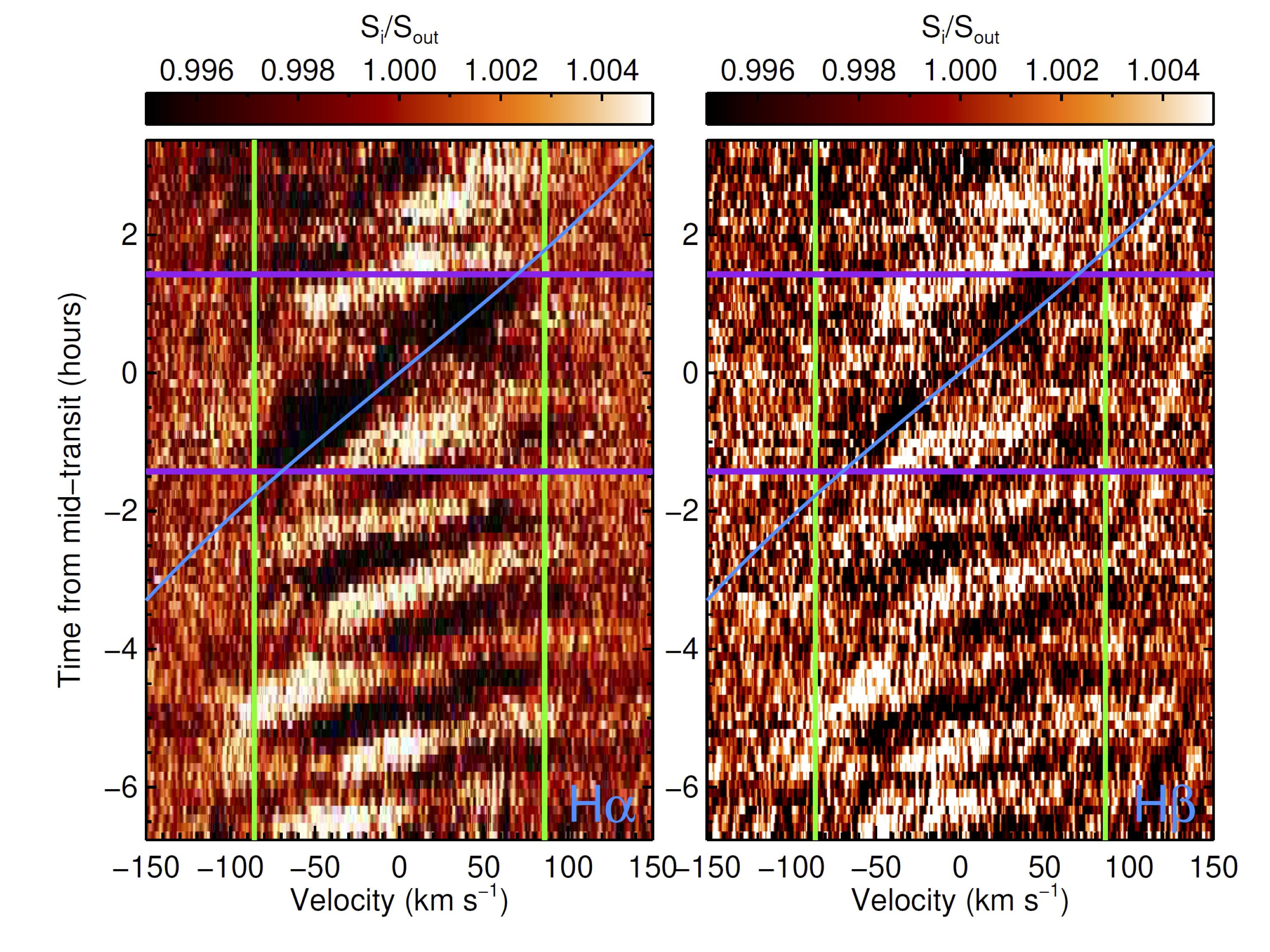
Read more: Cauley et al. 2021, AJ, 161, 152
A Unicorn in Monoceros: the 3M⊙ dark companion to the bright, nearby red giant V723 Mon is a non-interacting, mass-gap black hole candidate
2021-02-05
We report the discovery of the closest known black hole candidate as a binary companion to V723 Mon. V723 Mon is a nearby (d\=460 pc), bright evolved red giant in a high mass function nearly circular binary (𝑃 = 59.9 d, e approx. 0). Analyses of the stellar spectra and spectral energy distribution (SED) give 𝑇eff = 4440 K, 𝐿 = 173 𝐿s⊙ and 𝑅 = 22 𝑅⊙. Matching these parameters to MIST evolutionary models indicates a mass of the visible giant of 𝑀giant = 1.07 +/- 0.24 𝑀⊙. V723 Mon is a known variable star, previously classified as an eclipsing binary, but its All-Sky Automated Survey (ASAS), Kilodegree Extremely Little Telescope (KELT), and Transiting Exoplanet Survey Satellite (TESS) light curves are those of a nearly edge-on ellipsoidal variable. Detailed models of the light curves constrained by the period, radial velocities and stellar temperature give an inclination of 𝑖 = 87 deg, a mass ratio of 0.30 +/- 0.02, and a companion mass of 𝑀comp = 2.91 +/- 0.08 𝑀⊙, a stellar radius of the giant of 𝑅giant = 23.6 +/-1.0 𝑅⊙, and a giant mass of 𝑀giant = 0.87 +/-0.08 𝑀⊙ , consistent with our other estimates. We identify a likely non-stellar, diffuse veiling component with contributions in the 𝐵 and 𝑉-band of ~64% and ~23%, respectively, and a luminosity of ~20 𝐿⊙. The SED and the absence of continuum eclipses imply that the companion mass must be dominated by a compact object even if the companion is a binary. We do observe eclipses of the Balmer lines when the dark companion passes behind the giant, but their velocity spreads are low compared to observed accretion disks. The X-ray luminosity of the system is 𝐿X = 1 x 10^30 erg/s, corresponding to 𝐿/𝐿edd ~10^-9. The simplest explanation for the massive companion is a single compact object, most likely a black hole in the “mass gap”, although a double neutron star binary is possible.
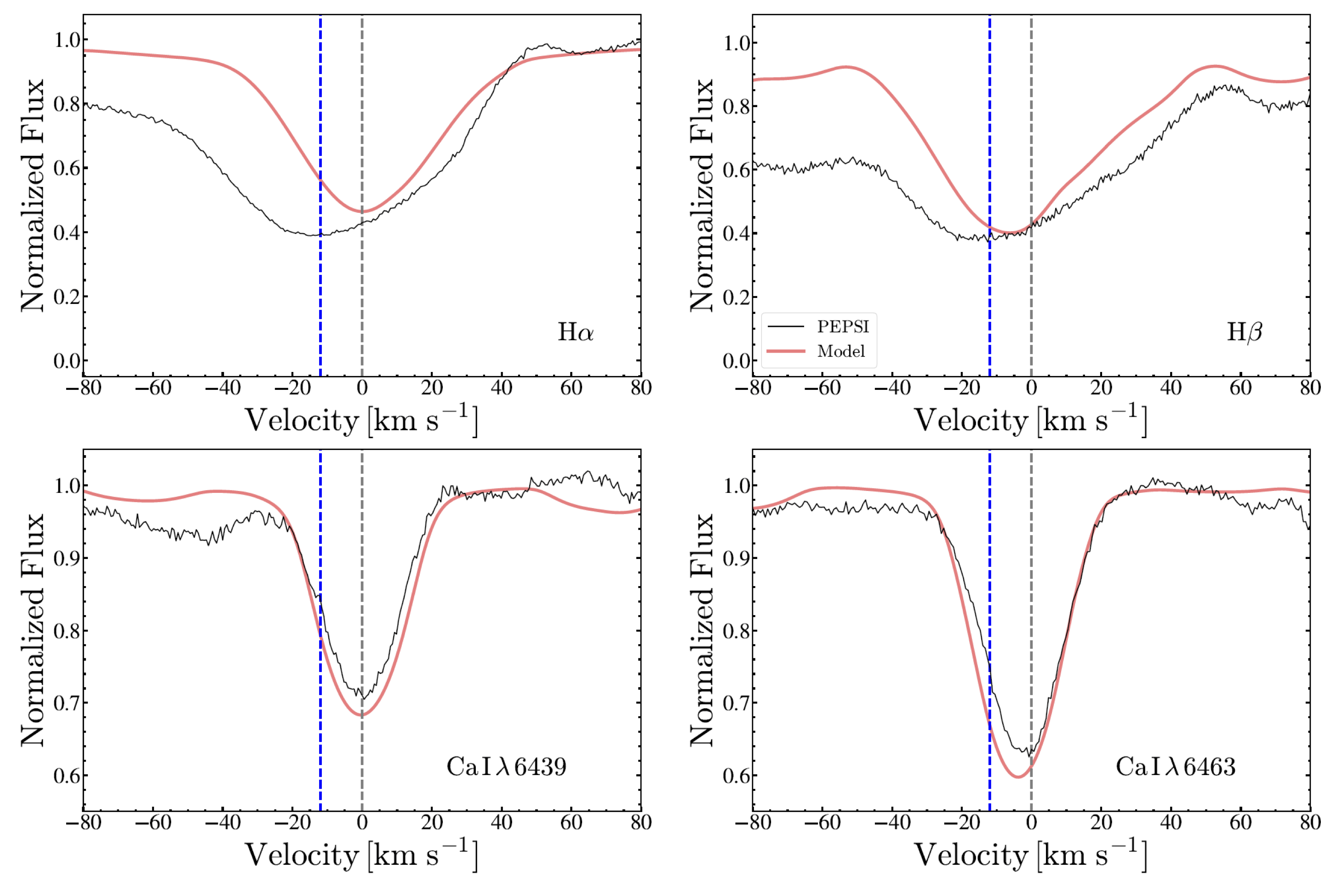
Read more: Jayasinghe et al. 2021, MNRAS, 504, 2577
Strongly magnetic Of?p star NGC 1624-2
2021-01-08
NGC 1624-2 is an O7f?p star with a reported probable polar magnetic field strength ≥20 kG, which is the strongest magnetic field ever measured in an O-type star. We study the variability of the mean longitudinal magnetic field <Bz> and the mean field modulus to obtain constraints on its field geometry. Only one magnetic pole is observable over the rotation cycle. The approximately sinusoidal variation of <Bz> and the ratio of the values of the extrema of indicate that there is an important component of the field that is dipolar. The <Bz> values measured over the rotation cycle are in the range from -0.2 to 4.5 kG, whereas the values for vary between 9 and 12 kG. The <Bz> values obtained using the O III λ7455 emission line are in the range from 0.4 to 2.3 kG and show a variability pattern similar to that detected for the absorption lines. The fact that the phase of the <Bz> minimum coincides with the phase of the maximum, indicates that the field structure must significantly depart from a centred dipole. Further, we discuss the nature of the observed variable Stokes V profiles corresponding to a longitudinal field of negative polarity detected in the emission He I lines and present the first magnetohydrodynamical numerical simulations of the gas flow in the magnetosphere of this star.
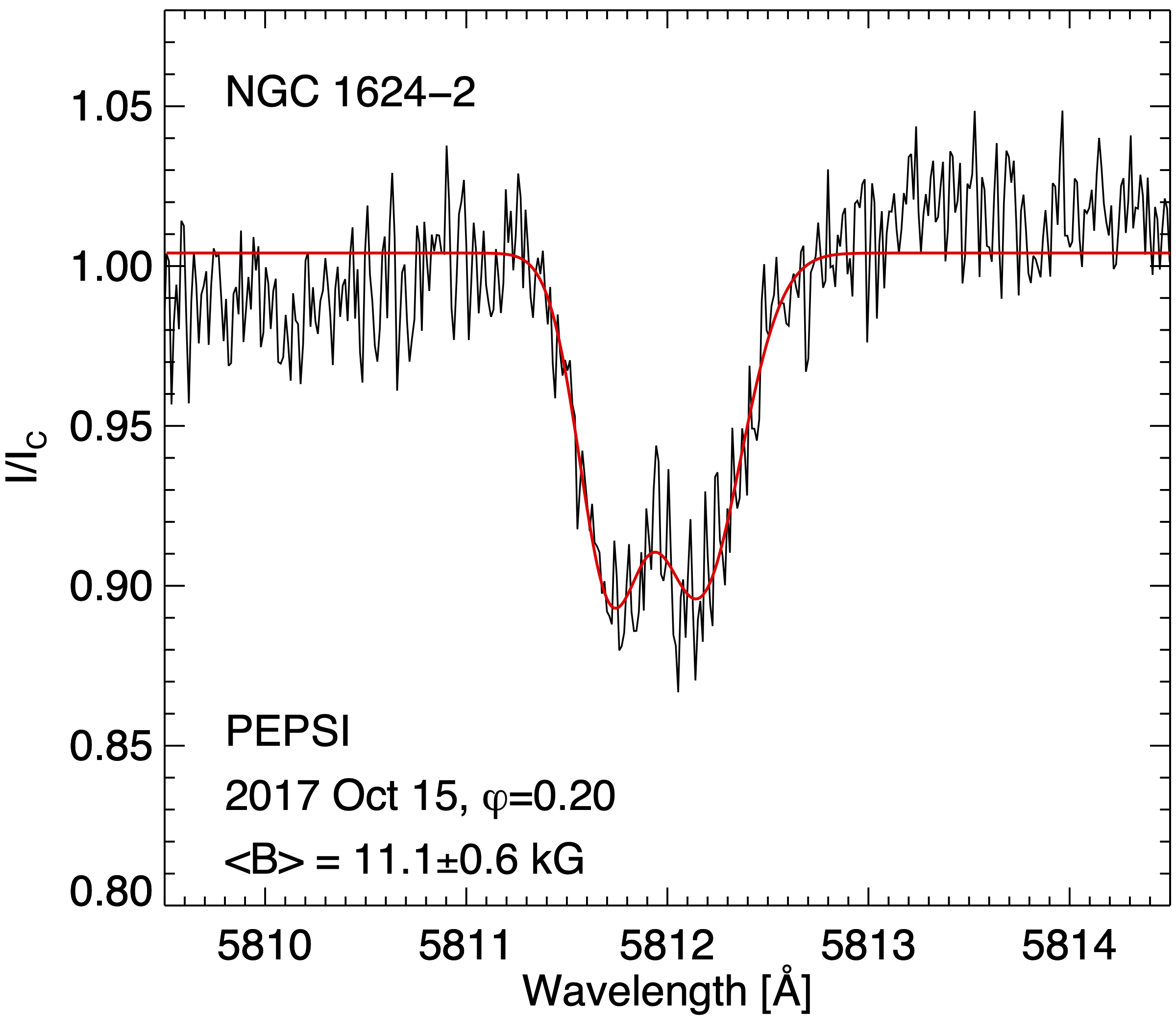
Read more: Järvinen et al. 2021, MNRAS, 501, 4534