
News
PEPSI Investigation, Retrieval, and Atlas of Numerous Giant Atmospheres (PIRANGA). IV. High-resolution Phased-resolved Spectroscopy of the Ultra-hot-Jupiter KELT-20b
2025-11-22
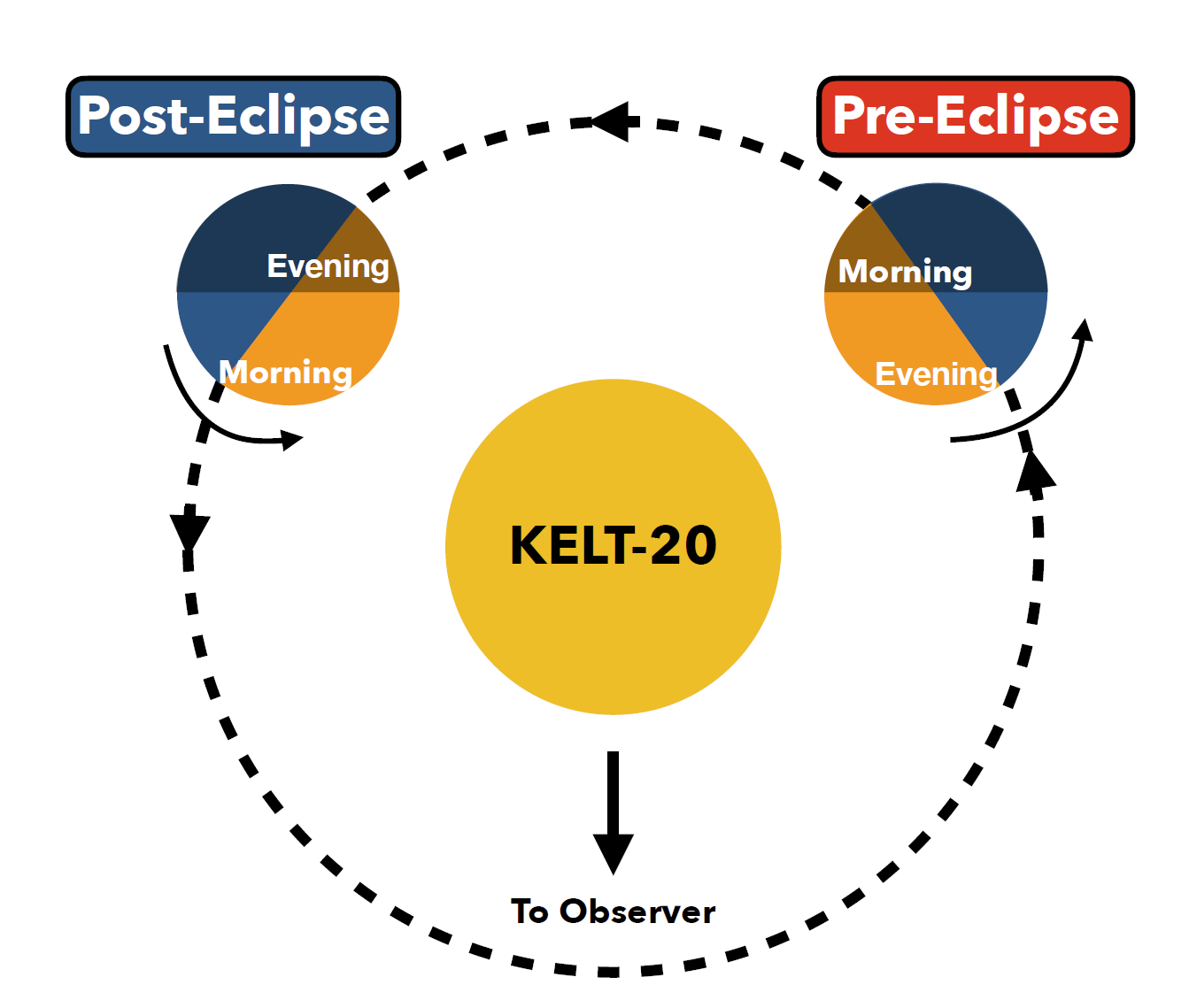
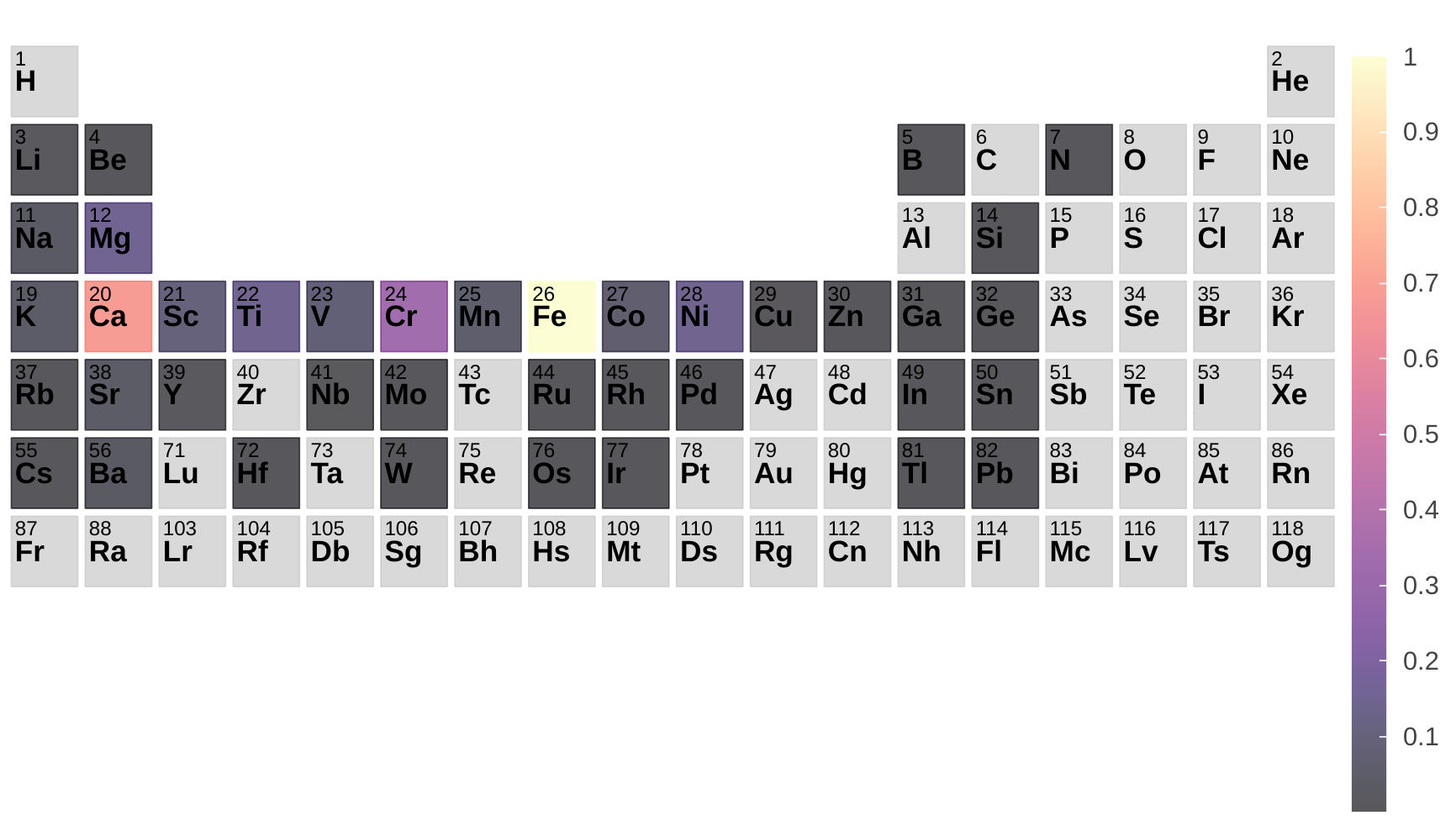
We present five datasets of high-resolution optical emission spectra of the ultra-hot Jupiter KELT-20 b with the PEPSI spectrograph. Using a Bayesian retrieval framework, we constrain its dayside pressure-temperature profile and abundances of Fe, Ni, and Ca, providing the first measurements for Ni and Ca for KELT-20 b in emission. We retrieve the pre- and post-eclipse datasets separately (corresponding to the evening and morning sides, respectively), and compare the constraints on their thermal structures and chemical abundances. We constrain lower abundances in the pre-eclipse datasets compared to the post-eclipse datasets. We interpret these results with an equilibrium chemistry model which suggests ∼ 10 − 30× supersolar refractory abundances. Due to the well-known degeneracy between absolute abundances and continuum opacities, the abundance ratios are more precise probes of the planetary abundances. Therefore we measure the abundance ratios [Ni/Fe] and [Ca/Fe] across these datasets and find they agree within 1σ. We constrain [Ni/Fe] to be consistent with solar within 2σ, and [Ca/Fe] to be 0.001-0.01× solar, not accounting for ionization.
Read more: Bonidie et al. 2026, AJ, 171, 34B
PEPSI Investigation, Retrieval, and Atlas of Numerous Giant Atmospheres (PIRANGA). II. Phase-resolved cross-correlation transmission spectroscopy of KELT-20b
2025-11-21
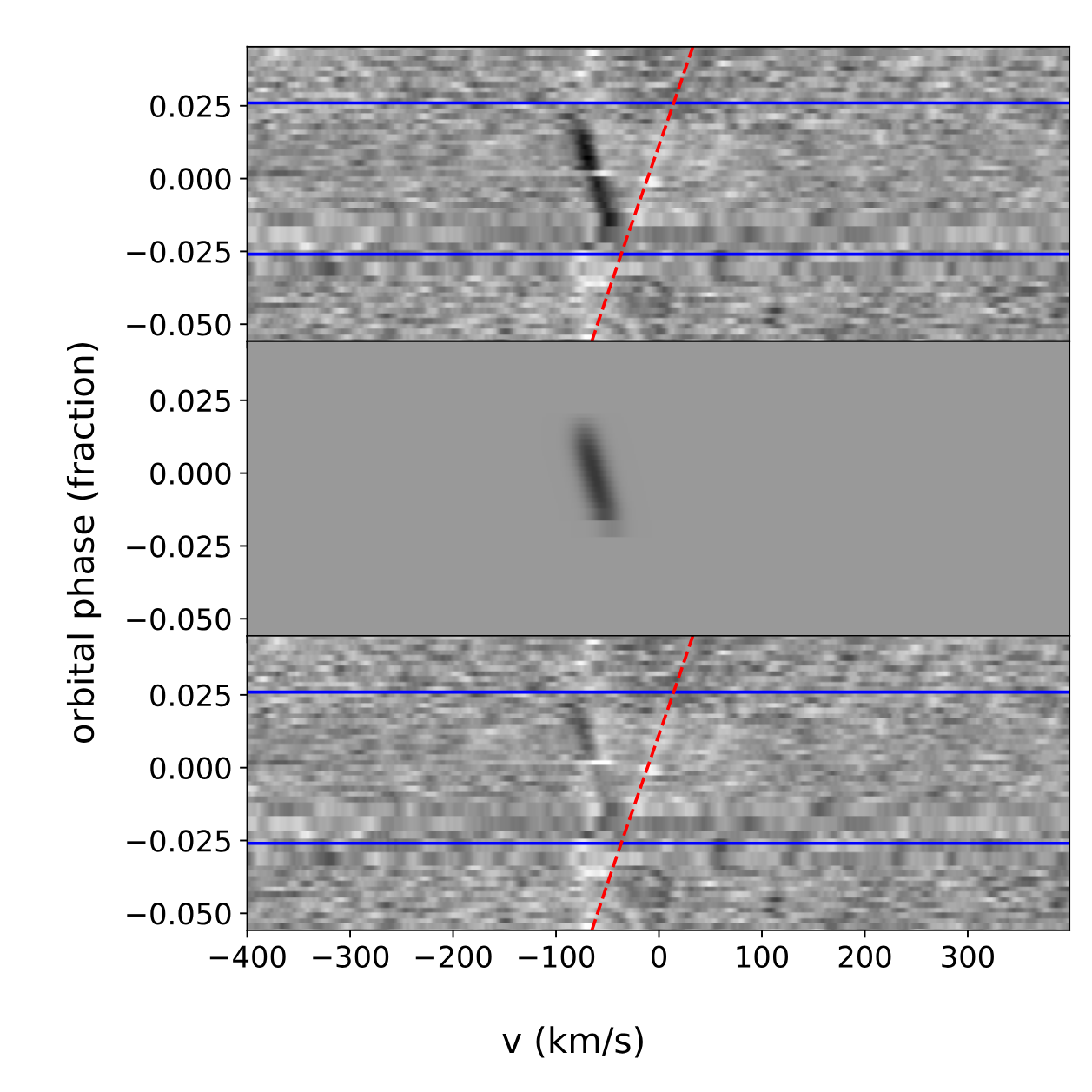
KELT-20b is a well-studied exoplanet within the highly observable ultra hot Jupiter (UHJ) regime, yet its multidimensional atmospheric structure remains largely unconstrained. Recent advances in instrumentation and increased general circulation model (GCM) complexity have enabled observers to resolve the imprints of more intricate physical mechanisms in time-resolved data. We performed high-resolution cross-correlation transmission spectroscopy (HRCCTS) on a single transit time series of KELT-20b, observed with PEPSI on the LBT. We detect Fe I (11.9σ) and Fe II (23.7σ) and tentatively detect Na I (3.4σ) and Cr I (3.3σ) upon combining nineteen in-transit exposures.
Read more: Basinger et al. 2025, MNRAS, 543, 4136
PEPSI Investigation, Retrieval, and Atlas of Numerous Giant Atmospheres (PIRANGA). III. Composition and winds in the atmosphere of TOI-1518b
2025-11-06
Ultra-hot Jupiters (UHJs) orbit close to their host stars and experience extreme conditions, making them important laboratories to explore atmospheric composition and dynamics. Transmission spectroscopy is a useful tool to reveal chemical species and their vertical and longitudinal distribution in the atmosphere. We use transmission spectra from the PEPSI (Potsdam Echelle Polarimetric and Spectroscopic Instrument) spectrograph on the Large Binocular Telescope to search for species and measure their time-resolved wind velocities in the atmosphere of TOI-1518 b. We detect Fe I at 7.8 σ and Fe II at 8.9 σ, and tentatively detect Cr I at 4.4 σ and Ni I at 4.0 σ. The time-resolved wind velocities of Fe I show a velocity pattern that is consistent with the velocity pattern of Fe II . TOI-1518 b joins a small sample of UHJs for which time-resolved wind velocities have been measured.
Read more: Basinger et al. 2025, MNRAS, 543, 4136
A search for Maunder-minimum candidate stars
2025-05-09
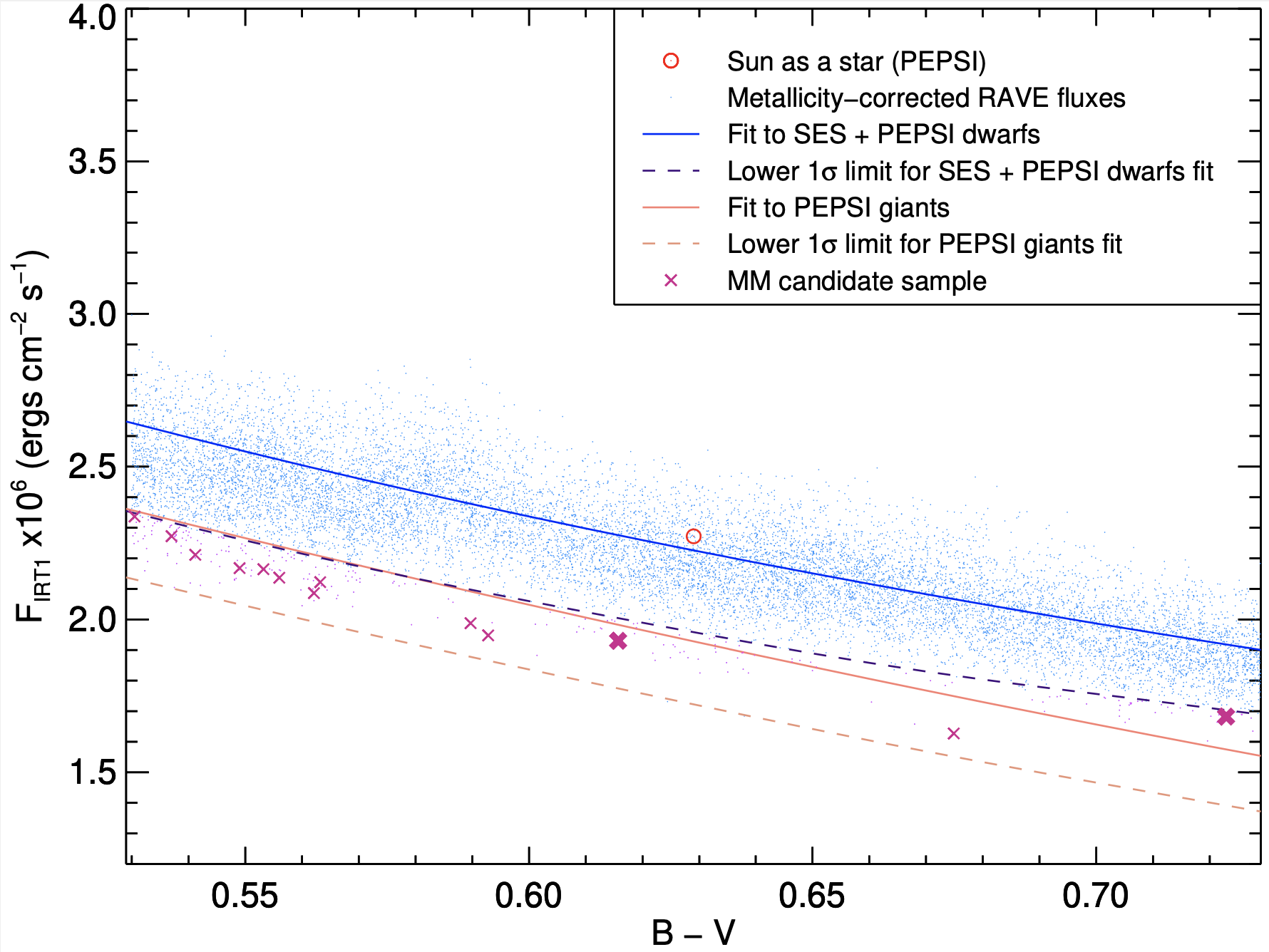
Stars with very low levels of magnetic activity provide an opportunity for a more quantitative comparison with the Sun during its Maunder minimum. We employ spectra from the RAVE survey in a search for particularly low-activity stars with the goal of identifying candidates for so-called Maunder-minimum stars. Spectra were used to measure the relative flux in the cores of the Ca II infrared-triplet (IRT) lines. Those were converted to absolute emission-line fluxes and were corrected with target fluxes from high-resolution STELLA and ultra-high-resolution PEPSI spectra. Absolute Ca II IRT fluxes for a total of 78 111 RAVE dwarf stars are presented and compared with fluxes of the 123 stars from our high-resolution STELLA+PEPSI sample. RAVE fluxes appear higher than the STELLA and PEPSI fluxes by on average 19% for IRT-1, 21% for IRT-2, and 25% for IRT-3 due to their lower spectral resolution. Our sample also spans a metallicity [Fe/H] range relative to the Sun of −1.5 to +0.5 dex. We confirm the strong dependency of IRT fluxes on metallicity and quantify it to be at most ±14% in the B–V range 0.53–0.73. Without a metallicity correction, practically all very-low-activity RAVE dwarfs show a super-solar metallicity. After correcting for spectral resolution and for metallicity, we find 13 RAVE stars out of 13 326 (0.1%) that fall well below our empirical lower flux bound from high-resolution versus B–V. For solar B–V, this relates to a photospheric uncorrected radiative loss in the IRT lines of log RIRT = −4.13 (≈20% below the solar-minimum value in late 2016). However, 11 targets turned out to be evolved stars based on their Gaia DR3 parallaxes. Two stars, TIC 352227373 (G2V) and TYC 7560-477-1 (G7V), are our only Maunder-minimum candidates from the present search. Contrary to the initial suggestion from the Mount-Wilson H&K Survey, we conclude that such stars are very rare.
Read more: Järvinen & Strassmeier 2025, A&A, 698, A93
PEPSI Investigation, Retrieval, and Atlas of Numerous Giant Atmospheres (PIRANGA). I. The Ubiquity of Fe I Emission and Inversions in Ultra Hot Jupiter Atmospheres
2025-03-27
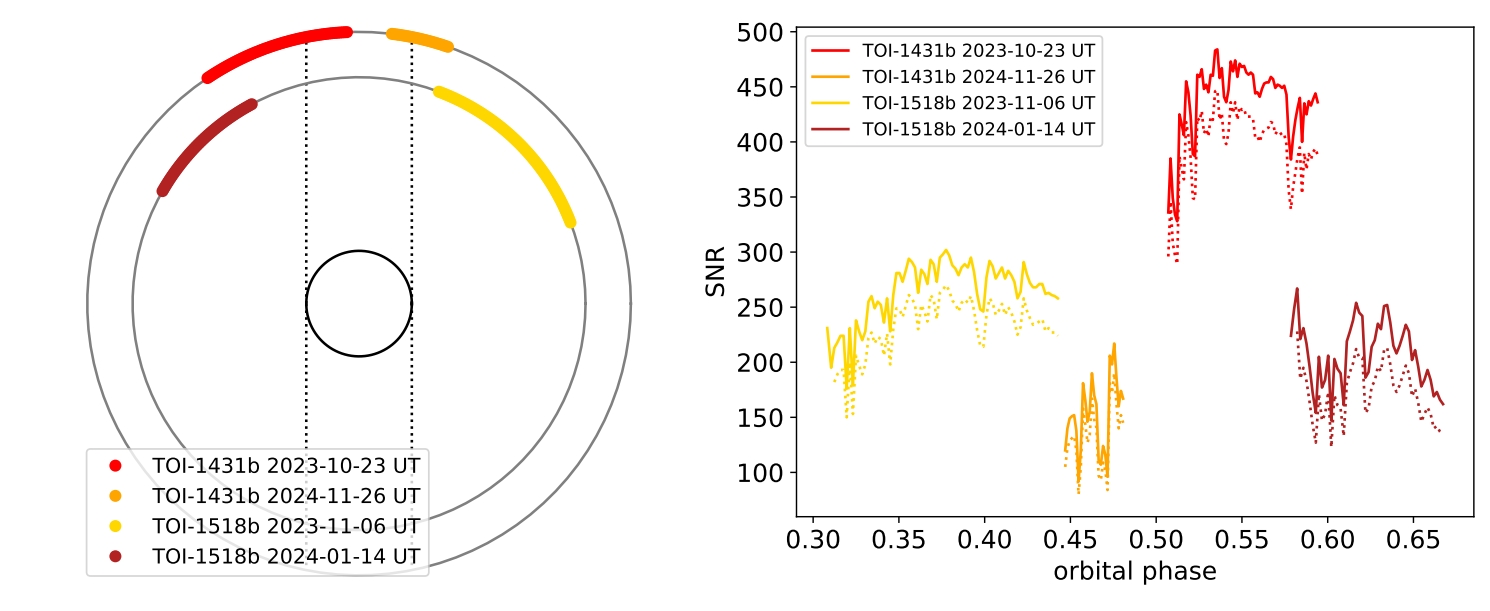
We present high-resolution optical emission spectroscopy observations of the ultra hot Jupiters (UHJs) TOI-1431b and TOI-1518b using the PEPSI spectrograph on the LBT. We detect emission lines from Fe I with a significance of 5.68σ and 7.68σ for TOI 1431b and TOI-1518b, respectively. We also tentatively detect Cr I emission from TOI-1431b at 4.32σ. For TOI-1518 b, we tentatively detect Ni I, Fe II, and Mg I at significance levels ranging from 3−4σ. Detection of emission lines indicates that both planets possess temperature inversions in their atmospheres, providing further evidence of the ubiquity of stratospheres among UHJs. By analyzing the population of hot Jupiters, we compare models that predict the distribution of planets in the temperature-gravity space, and find a recent global circulation model suite from Roth et al. (2024) provides a reasonable match to the observed onset of inversions at Teq∼2000 K. The ubiquity of strong Fe I emission lines among UHJs, together with the paucity of detections of TiO, suggest that atomic iron is the dominant optical opacity source in their atmospheres and can be responsible for the inversions.
Read more: Petz et al. 2025, AJ, 169, 267