
News
A Unicorn in Monoceros: the 3M⊙ dark companion to the bright, nearby red giant V723 Mon is a non-interacting, mass-gap black hole candidate
2021-02-05
We report the discovery of the closest known black hole candidate as a binary companion to V723 Mon. V723 Mon is a nearby (d\=460 pc), bright evolved red giant in a high mass function nearly circular binary (𝑃 = 59.9 d, e approx. 0). Analyses of the stellar spectra and spectral energy distribution (SED) give 𝑇eff = 4440 K, 𝐿 = 173 𝐿s⊙ and 𝑅 = 22 𝑅⊙. Matching these parameters to MIST evolutionary models indicates a mass of the visible giant of 𝑀giant = 1.07 +/- 0.24 𝑀⊙. V723 Mon is a known variable star, previously classified as an eclipsing binary, but its All-Sky Automated Survey (ASAS), Kilodegree Extremely Little Telescope (KELT), and Transiting Exoplanet Survey Satellite (TESS) light curves are those of a nearly edge-on ellipsoidal variable. Detailed models of the light curves constrained by the period, radial velocities and stellar temperature give an inclination of 𝑖 = 87 deg, a mass ratio of 0.30 +/- 0.02, and a companion mass of 𝑀comp = 2.91 +/- 0.08 𝑀⊙, a stellar radius of the giant of 𝑅giant = 23.6 +/-1.0 𝑅⊙, and a giant mass of 𝑀giant = 0.87 +/-0.08 𝑀⊙ , consistent with our other estimates. We identify a likely non-stellar, diffuse veiling component with contributions in the 𝐵 and 𝑉-band of ~64% and ~23%, respectively, and a luminosity of ~20 𝐿⊙. The SED and the absence of continuum eclipses imply that the companion mass must be dominated by a compact object even if the companion is a binary. We do observe eclipses of the Balmer lines when the dark companion passes behind the giant, but their velocity spreads are low compared to observed accretion disks. The X-ray luminosity of the system is 𝐿X = 1 x 10^30 erg/s, corresponding to 𝐿/𝐿edd ~10^-9. The simplest explanation for the massive companion is a single compact object, most likely a black hole in the “mass gap”, although a double neutron star binary is possible.
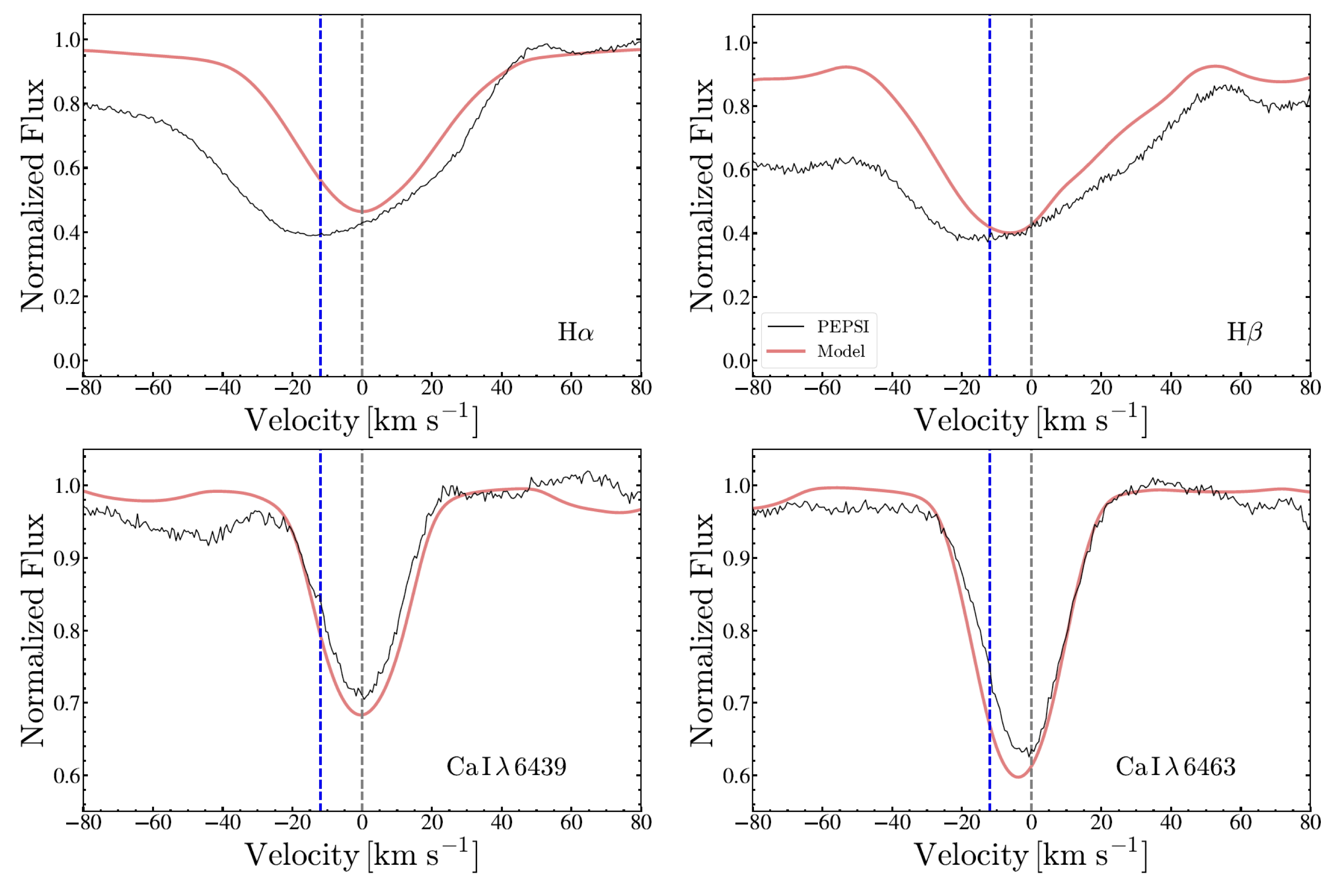
Read more: Jayasinghe et al. 2021, MNRAS, 504, 2577
Strongly magnetic Of?p star NGC 1624-2
2021-01-08
NGC 1624-2 is an O7f?p star with a reported probable polar magnetic field strength ≥20 kG, which is the strongest magnetic field ever measured in an O-type star. We study the variability of the mean longitudinal magnetic field <Bz> and the mean field modulus to obtain constraints on its field geometry. Only one magnetic pole is observable over the rotation cycle. The approximately sinusoidal variation of <Bz> and the ratio of the values of the extrema of indicate that there is an important component of the field that is dipolar. The <Bz> values measured over the rotation cycle are in the range from -0.2 to 4.5 kG, whereas the values for vary between 9 and 12 kG. The <Bz> values obtained using the O III λ7455 emission line are in the range from 0.4 to 2.3 kG and show a variability pattern similar to that detected for the absorption lines. The fact that the phase of the <Bz> minimum coincides with the phase of the maximum, indicates that the field structure must significantly depart from a centred dipole. Further, we discuss the nature of the observed variable Stokes V profiles corresponding to a longitudinal field of negative polarity detected in the emission He I lines and present the first magnetohydrodynamical numerical simulations of the gas flow in the magnetosphere of this star.
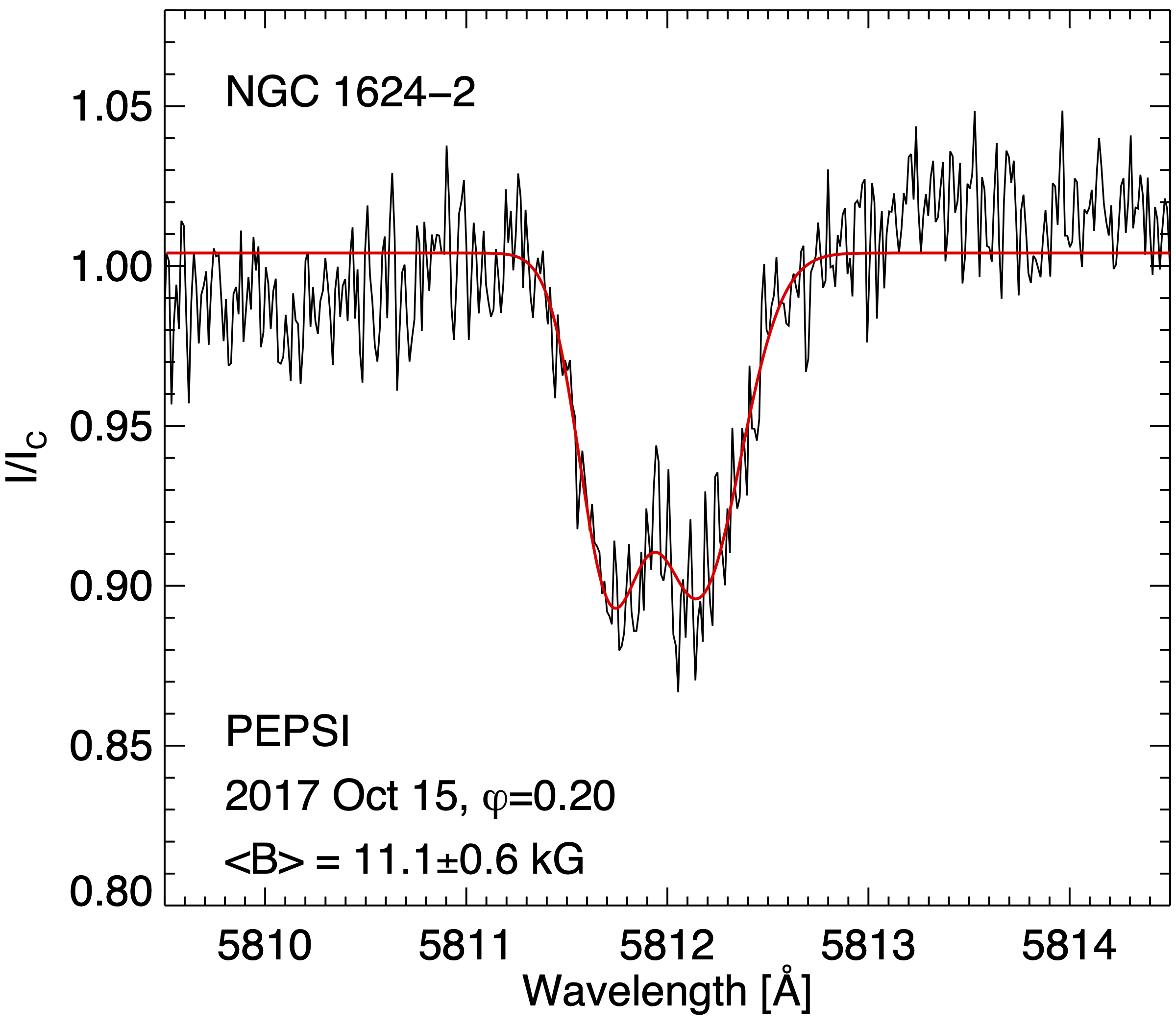
Read more: Järvinen et al. 2021, MNRAS, 501, 4534
Mono-enriched stars and Galactic chemical evolution - Possible biases in observations and theory
2020-10-01
A long sought after goal using chemical abundance patterns derived from metal-poor stars is to understand the chemical evolution of the Galaxy and to pin down the nature of the first stars (Pop III). Metal-poor, old, unevolved stars are excellent tracers as they preserve the abundance pattern of the gas from which they were born, and hence they are frequently targeted in chemical tagging studies. Here, we use a sample of 14 metal-poor stars observed with the high-resolution spectrograph called the Potsdam Echelle Polarimetric and Spectroscopic Instrument (PEPSI) at the Large Binocular Telescope (LBT) to derive abundances of 32 elements (34 including upper limits). We present well-sampled abundance patterns for all stars obtained using local thermodynamic equilibrium (LTE) radiative transfer codes and one-dimensional (1D) hydrostatic model atmospheres. However, it is currently well-known that the assumptions of 1D and LTE may hide several issues, thereby introducing biases in our interpretation as to the nature of the first stars and the chemical evolution of the Galaxy. Hence, we use non-LTE (NLTE) and correct the abundances using three-dimensional (3D) model atmospheres to present a physically more reliable pattern. In order to infer the nature of the first stars, we compare unevolved, cool stars, which have been enriched by a single event (‘mono-enriched’), with a set of yield predictions to pin down the mass and energy of the Pop III progenitor. To date, only few bona fide second generation stars that are mono-enriched are known. A simple χ 2 -fit may bias our inferred mass and energy just as much as the simple 1D LTE abundance pattern, and we therefore carried out our study with an improved fitting technique considering dilution and mixing. Our sample presents Carbon Enhanced Metal-Poor (CEMP) stars, some of which are promising bona fide second generation (mono-enriched) stars. The unevolved, dwarf BD+09_2190 shows a mono-enriched signature which, combined with kinematical data, indicates that it moves in the outer halo and likely has been accreted onto the Milky Way early on. The Pop III progenitor was likely of 25.5 M☉ and 0.6 foe (0.6 1051 erg) in LTE and 19.2 M☉ and 1.5 foe in NLTE, respectively. Finally, we explore the predominant donor and formation site of the rapid and slow neutron-capture elements.
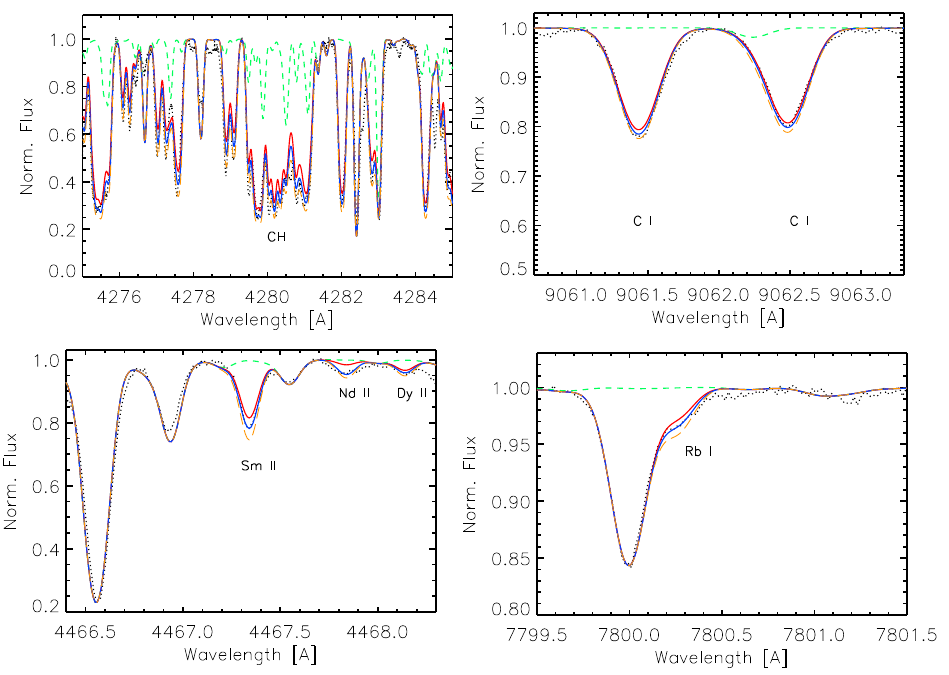
Read more: Hansen et al. 2020, A&A, 643A, 49
Pepsi Exoplanet Transit Survey Workshop
2020-09-07
The Pepsi Exoplanet Transit Survey (PETS@LBT) Workshop is scheduled on
Tuesday Sep 22 - 6am to 9am AZ time (13:00-16:00 UTC)
In this Workshop, we will discuss and wrap-up our community proposal for a large LBT program, to be submitted shortly thereafter. We propose a high-resolution spectroscopic survey of exoplanet transits, secondary eclipses, and host-star characterizations of selected targets; dubbed the “PEPSI/LBT Exoplanet Transit Survey (PETS)”. Immediate goal is characterizing the planetary and stellar atmospheres in detail. During this 3-hr Zoom meeting we shall emphasis again the strengths and uniqueness of this proposal and recall shortcomings. The survey requests 40 nights in total or 12.5 nights per semester for two years in order to observe a representative number of targets starting in semester 2021A.
The zoom link will be provided by e-mail.
Survey Announcement (PDF)
On the Chemical Abundance of HR 8799 and the Planet c
2020-09-03
Comparing chemical abundances of a planet and the host star reveals the origin and formation pathway of the planet. Stellar abundance is measured with high-resolution spectroscopy. Planet abundance, on the other hand, is usually inferred from low-resolution data. For directly imaged exoplanets, the data are available from a slew of high-contrast imaging/spectroscopy instruments. Here, we study the chemical abundance of HR 8799 and its planet c. We measure stellar abundance using LBT/PEPSI (R=120,000) and archival HARPS data: stellar [C/H], [O/H], and C/O are 0.11±0.12, 0.12±0.14, and 0.54+0.09-0.12, all consistent with solar values. We conduct atmospheric retrieval using newly obtained Subaru/CHARIS data together with archival Gemini/GPI and Keck/OSIRIS data. We model the planet spectrum with petitRADTRANS and conduct retrieval using PyMultiNest. Retrieved planetary abundance can vary by ∼0.5 dex, from sub-stellar to stellar C and O abundances. The variation depends on whether strong priors are chosen to ensure a reasonable planet mass. Moreover, comparison with previous works also reveals inconsistency in abundance measurements. We discuss potential issues that can cause the inconsistency, e.g., systematics in individual data sets and different assumptions in the physics and chemistry in retrieval. We conclude that no robust retrieval can be obtained unless the issues are fully resolved.
Read more: Wang et al. 2020, AJ, 160, 150