
News
Lithium in T Corona Borealis
2020-06-21
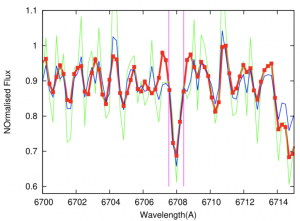
T Coronae Borealis is a recurrent, symbiotic nova system currently in quiescence between its periodic ≍80 yr cycle of eruptions. Observations during inter-outburst epochs provide an opportunity to study properties of the accretion disk and the M red giant. Here we present new irradiated (blackbody veiling) models, incorporating modern molecular opacities and line lists, of spectra derived from high-resolution (22,000 ≲ R ≲ 120,000) optical echelle observations obtained at two epochs, one prior to and one post the 2015 rebrightening event at similar spectroscopic system phase. We find a lithium abundance in the secondary at both epochs to be comparable. The non-irradiated (classical) model atmospheres yield a lithium abundance, A(Li) = 1.3 ± 0.1. The irradiated model (veiled) atmospheres, which are likely a better representation of the system in which the white dwarf and accretion disk illuminate the red giant, give A(Li) = 2.4 ± 0.1.
Read more: Woodward et al. 2020, AJ, 159, 231
No Consistent Atmospheric Absorption Detected for the Ultra-hot Jupiter WASP-189b
2020-05-01
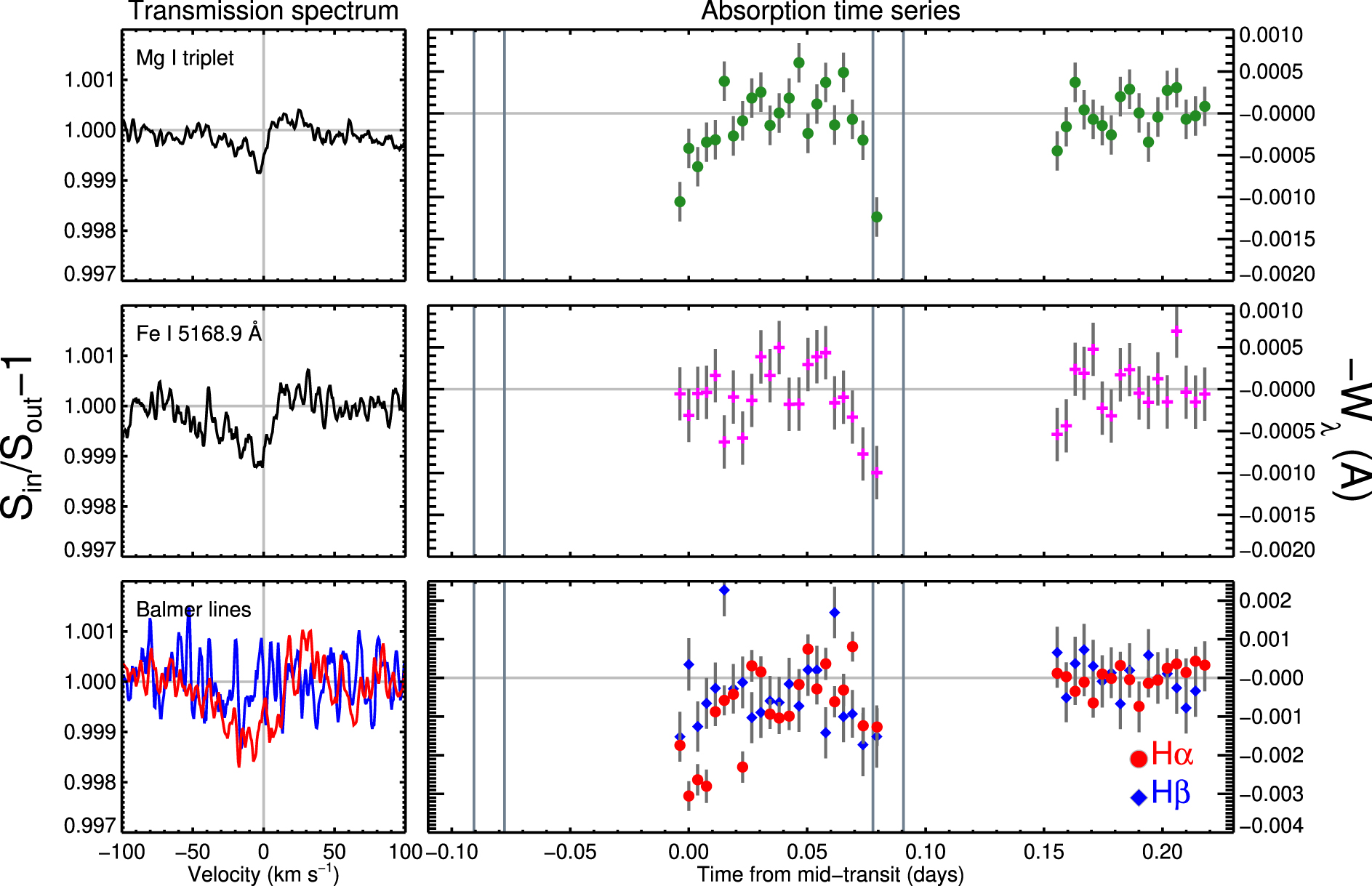
We observed a partial transit of the ultra-hot Jupiter WASP-189 b with PEPSI on the LBT. We detect a highly variable transit signal in multiple atomic transitions, including H-alpha, Fe I, and Mg I. The signal is not consistent with a transiting planetary atmosphere. We suggest instead that the in-transit signal is due to an inhomogeneous stellar surface. Our observations demonstrate the lack of a highly extended atmosphere in common optical atomic tracers. Although WASP-189 is very bright, atmospheric characterization of the planet will be difficult due to the small transit depth and apparently compact atmosphere.
Read more: Cauley et al. 2020, RNAAS, 4, 53
Earth as transiting planet
2020-03-06
January 2019 featured a total lunar eclipse. The Moon dimmed by a factor of 20,000 (10.75 mag) during totality. Therefore, the light gathering capability of the 11.8 m Large Binocular Telescope (LBT) in Arizona was needed for the observations. Additionally, the high spectral resolution of the Potsdam Echelle Polarimetric and Spectroscopic Instrument (PEPSI) was necessary to separate the expected tiny spectral-line absorptions of the Earth’s atmosphere from the normal solar spectrum at unprecedented spectral resolution and in polarized light. The radial velocities trace a wavelength dependent Rossiter-McLaughlin effect of the Earth eclipsing the Sun as seen from the Tycho crater confirming earlier observations. No line polarization of any spectral-line feature is detected outside nor inside eclipse. This places an upper limit of ≈0.2% on the degree of line polarization during transmission through Earth’s atmosphere and magnetosphere.
Read more: Strassmeier et al. 2020, A&A, 635, 156
Monitoring solar activity with PEPSI
2020-02-01
Synoptic Sun-as-a-star observations are carried out with the Potsdam Echelle Polarimetric and Spectroscopic Instrument (PEPSI), which receives light from the Solar Disk-Integration (SDI) telescope. Daily spectra are produced with a high signal-to-noise ratio, providing access to unprecedented quasi-continuous, long-term, disk-integrated spectra of the Sun with high spectral and temporal resolution. We developed tools to monitor and study solar activity on different time-scales ranging from daily changes, over periods related to solar rotation, to annual and decadal trends. Strong chromospheric absorption lines, such as the Ca II H & K λ3934 & 3968 Å lines, are powerful diagnostic tools for solar activity studies, since they trace the variations of the solar magnetic field. Other lines, such as Hα λ6563 Å line and the near-infrared (NIR) Ca II λ8542 Å line, provide additional information on the physical properties in this highly complex and dynamic atmospheric layer. Currently, we work on a data pipeline for extraction, calibration, and analysis of the PEPSI/SDI data. We compare the SDI data with daily spectra from the Integrated Sunlight Spectrometer (ISS), which is part of the Synoptic Long-Term Investigation of the Sun (SOLIS) facility operated by the U.S. National Solar Observatory (NSO). This facilitates cross-calibration and validation of the SDI data.
Download PDF.
A Magnetic Morphology Shift in Old Solar-type Stars
2019-12-05
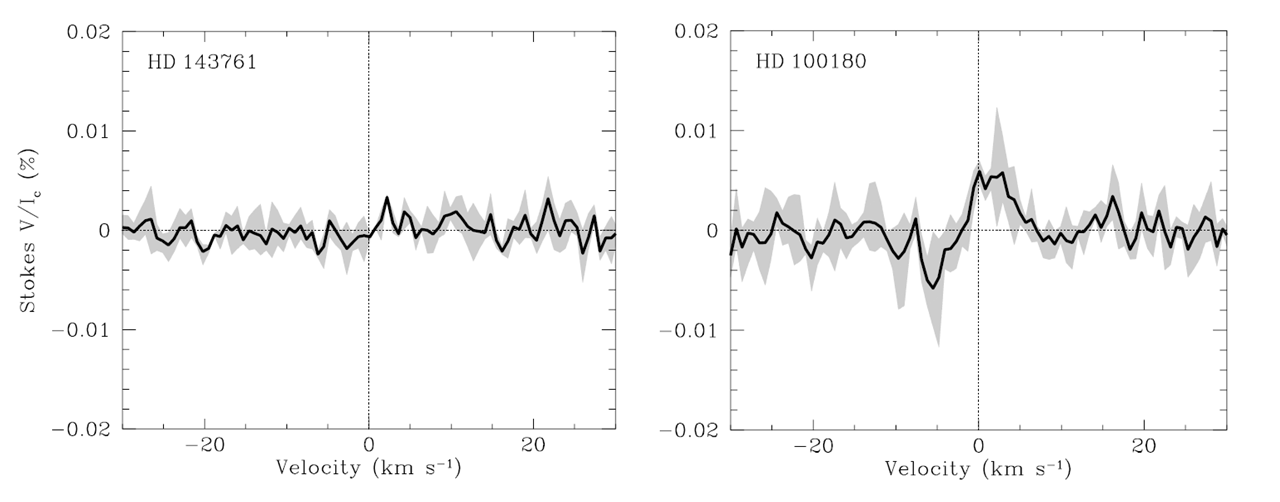
LBT/PEPSI spectropolarimetry tested the hypothesis that the surface magnetic morphology is a crucial component for the spin down of stars. Solar-type stars are born with relatively rapid rotation and strong magnetic fields. Through a process known as magnetic braking, the rotation slows over time as stellar winds gradually remove angular momentum from the system. The rate of angular momentum loss depends sensitively on the magnetic morphology, with the dipole field exerting the largest torque on the star. One hypothesis to explain this reduction in efficiency is a shift in magnetic morphology from predominantly larger to smaller spatial scales. We tested this hypothesis with spectropolarimetric measurements of two stars that sample chromospheric activity levels on opposite sides of the proposed magnetic transition. As predicted, the more active star (HD 100180) exhibits a significant circular polarization signature due to a non-axisymmetric large-scale magnetic field, while the less active star (HD 143761) shows no significant signal.
Read more: Metcalfe et al. 2019, ApJ, 887, L38