
News
The PEPSI Exoplanet Transit Survey (PETS) IV: Assessing the atmospheric chemistry of KELT-20b
2023-12-08
Most ultra hot Jupiters (UHJs) show evidence of temperature inversions, in which temperature increases with altitude over a range of pressures. Temperature inversions can occur when there is a species that absorbs the stellar irradiation at a relatively high level of the atmospheres. However, the species responsible for this absorption remains unidentified. In particular, the UHJ KELT-20b is known to have a temperature inversion. Using high resolution emission spectroscopy from LBT/PEPSI we investigate the atomic and molecular opacity sources that may cause the inversion in KELT-20b, as well as explore its atmospheric chemistry. We confirm the presence of Fe I with a significance of 17𝜎. We also report a tentative 4.3𝜎 detection of Ni I. A nominally 4.5𝜎 detection of Mg I emission in the PEPSI blue arm is likely in fact due to aliasing between the Mg I cross-correlation template and the Fe I lines present in the spectrum. We cannot reproduce a recent detection of Cr I, while we do not have the wavelength coverage to robustly test past detections of Fe II and Si I. Together with non-detections of molecular species like TiO, this suggests that Fe I is likely to be the dominant optical opacity source in the dayside atmosphere of KELT-20b and may be responsible for the temperature inversion. We explore ways to reconcile the differences between our results and those in literature and point to future paths to understand atmospheric variability.
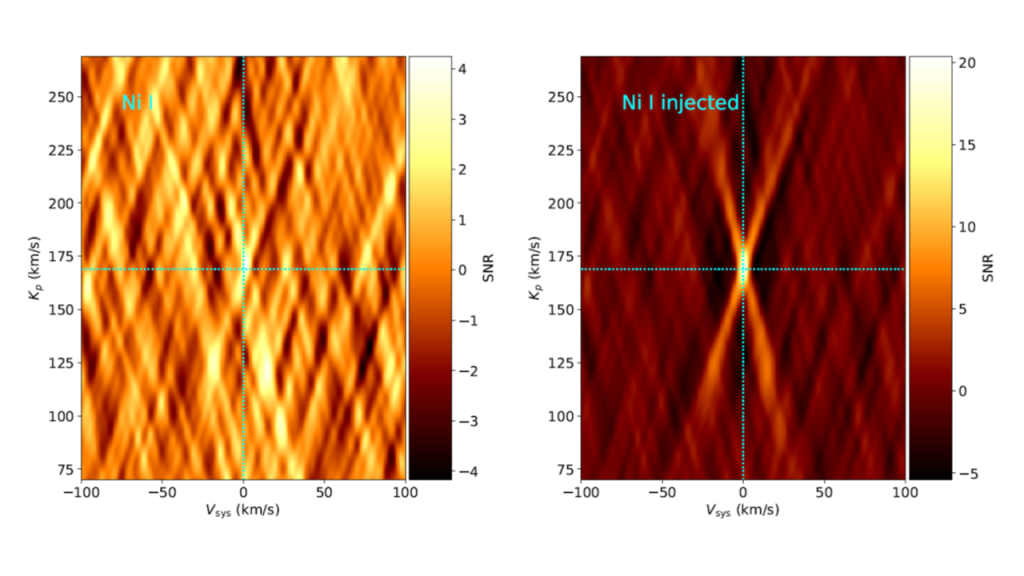
Read more: Petz et al. 2023, MNRAS, 527, 7079
Asteroseismology and Spectropolarimetry of the Exoplanet Host Star lambda Serpentis
2023-09-01
The bright star lam Ser hosts a hot Neptune with a minimum mass of 13.6 MEarth and a 15.5 day orbit. It also appears to be a solar analog, with a mean rotation period of 25.8 days and surface differential rotation very similar to the Sun. We detect solar-like oscillations in time series photometry from the Transiting Exoplanet Survey Satellite (TESS), and we derive precise asteroseismic properties from detailed modeling. We obtain new spectropolarimetric data, and we use them to reconstruct the large-scale magnetic field morphology. We reanalyze the complete time series of chromospheric activity measurements from the Mount Wilson Observatory, and we present new X-ray and ultraviolet observations from the Chandra and Hubble space telescopes. Finally, we use the updated observational constraints to assess the rotational history of the star and to estimate the wind braking torque. We conclude that the remaining uncertainty on stellar age currently prevents an unambiguous interpretation of the properties of lam Ser, and that the rate of angular momentum loss appears to be higher than for other stars with similar Rossby number. Future asteroseismic observations may help to improve the precision of the stellar age.
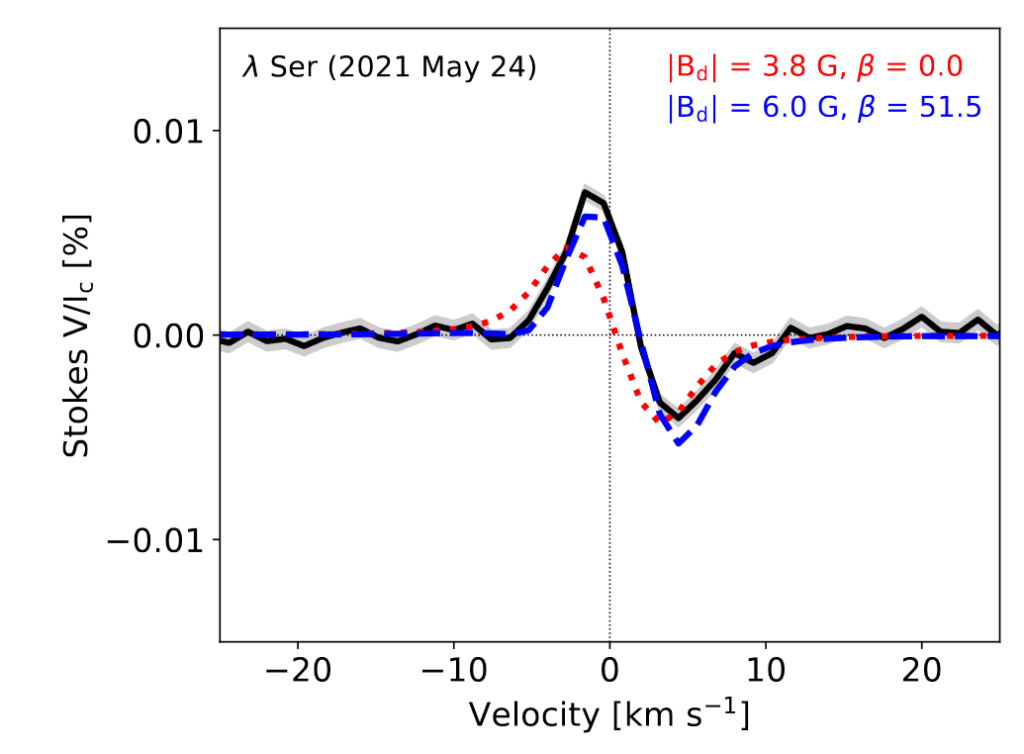
Read more: Metcalfe et al. 2023, AJ, 166, 167
Searching for magnetic fields in pulsating A-type stars
2023-08-21
Numerous δ Sct and γ Dor pulsators are identified in the region of the Hertzsprung-Russell diagram that is occupied by chemically peculiar magnetic Ap stars. The connection between δ Sct and γ Dor pulsations and the magnetic field in Ap stars is however not clear: theory suggests for magnetic Ap stars some critical field strengths for pulsation mode suppression by computing the magnetic damping effect for selected p and g modes. To test these theoretical considerations, we obtained PEPSI spectropolarimetric snapshots of the typical Ap star HD 340577, for which δ Sct- like pulsations were recently detected in TESS data, and the γ Dor pulsator HR 8799, which is a remarkable system with multiple planets and two debris disks. Our measurements reveal the presence of a magnetic field with a strength of several hundred Gauss in HD 340577. The measured mean longitudinal field would be the strongest field measured so far in a δ Sct star if the pulsational character of HD 340577 is confirmed spectroscopically. No magnetic field is detected in HR 8799.
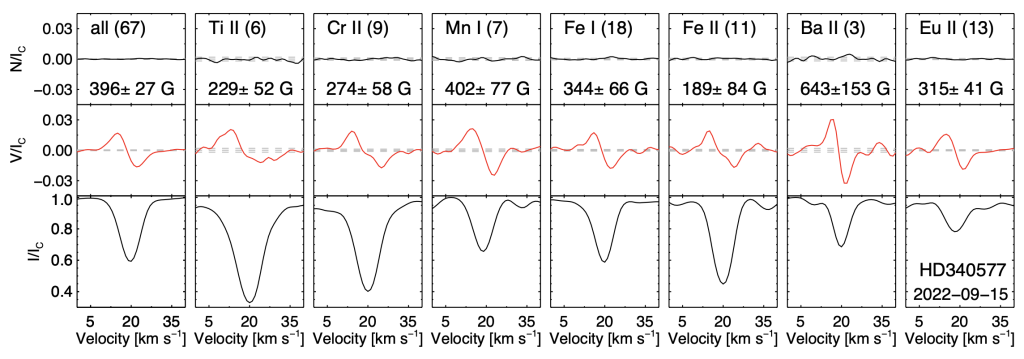
Read more: Hubrig et al. 2023, MNRAS, 526, L83
Zeeman Doppler Imaging of ksi Boo A and B
2023-05-15
A magnetic-field surface map for both stellar components of the young visual binary ksi Boo AB (A: G8V, B: K5V) is presented. Employed are high resolution Stokes-V spectra obtained with the Potsdam Echelle Polarimetric and Spectroscopic Instrument (PEPSI) at the Large Binocular Telescope (LBT). Stokes V line profiles are inverted with our iMAP software and compared to previous inversions. We employed an iterative regularization scheme without the need of a penalty function and incorporated a three-component description of the surface magnetic-field vector. The spectral resolution of our data is 130,000 (0.040-0.055A) and have signal-to-noise ratios (S/N) of up to three thousand per pixel depending on wavelength. A singular-value decomposition (SVD) of a total of 1811 spectral lines is employed for averaging Stokes-V profiles. Our mapping is accompanied by a residual bootstrap error analysis. Magnetic flux densities of the radial field component of up to plus/minus 115 ± 5 G were reconstructed for ksi Boo A while up to plus/minus 55 ± 3G were reconstructed for ksi Boo B. ksi Boo A's magnetic morphology is characterized by a very high latitude, nearly polar, spot of negative polarity and three low-to-mid latitude spots of positive polarity while ksi Boo B's morphology is characterized by four low-to-mid latitude spots of mixed polarity. No polar magnetic field is reconstructed for the cooler ksi Boo B star. Both our maps are dominated by the radial field component, containing 86 and 89 percent of the magnetic energy of ksi Boo A and B, respectively. We found only weak azimuthal and meridional field densities on both stars (plus/minus 15-30 G), about a factor two weaker than what was seen previously for ksi Boo A. The phase averaged longitudinal field component and dispersion is +4.5 ± 1.5G for ksi Boo A and -5.0 ± 3.0 G for ksi Boo B.
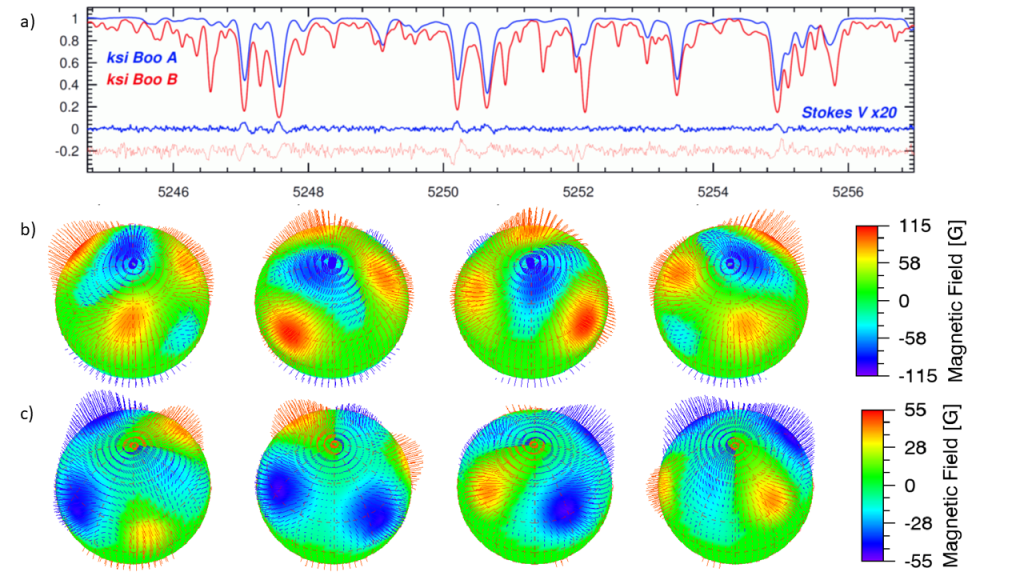
Read more: Strassmeier, Carroll, & Ilyin 2023, A&A, 674, 118
Constraints on Magnetic Braking from the G8 Dwarf Stars 61 UMa and Tau Cet
2023-04-25
During the first half of their main-sequence lifetimes, stars rapidly lose angular momentum to their magnetized winds, a process known as magnetic braking. Recent observations suggest a substantial decrease in the magnetic braking efficiency when stars reach a critical value of the Rossby number, the stellar rotation period normalized by the convective overturn timescale. Cooler stars have deeper convection zones with longer overturn times, reaching this critical Rossby number at slower rotation rates. The nature and timing of the transition to weakened magnetic braking has previously been constrained by several solar analogs and two slightly hotter stars. In this Letter, we derive the first direct constraints from stars cooler than the Sun. We present new spectropolarimetry of the old G8 dwarf τ Cet from the Large Binocular Telescope, and we reanalyze a published Zeeman Doppler image of the younger G8 star 61 UMa, yielding the large-scale magnetic field strengths and morphologies. We estimate mass-loss rates using archival X-ray observations and inferences from Lyα measurements, and we adopt other stellar properties from asteroseismology and spectral energy distribution fitting. The resulting calculations of the wind braking torque demonstrate that the rate of angular momentum loss drops by a factor of 300 between the ages of these two stars (1.4–9 Gyr), well above theoretical expectations. We summarize the available data to help constrain the value of the critical Rossby number, and we identify a new signature of the long-period detection edge in recent measurements from the Kepler mission.
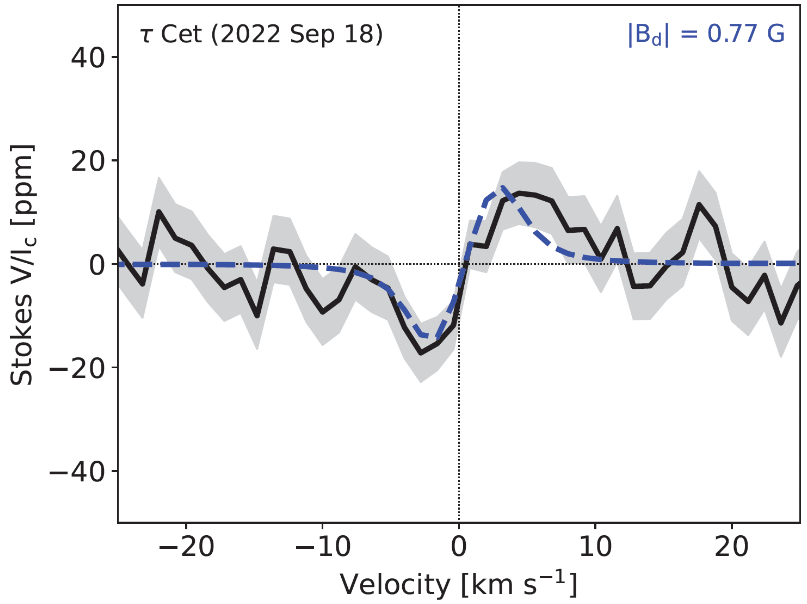
Read more: Metcalfe et al. 2023, ApJ, 948, L6