
News
Revised carbon 12C/13C isotope ratio of α Aurigae
2019-03-07
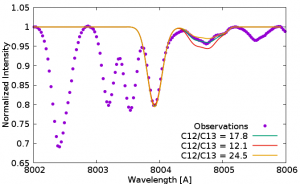
The new measure of the carbon 12C/13C isotope ratio of the primary component of Capella, 17.8 ± 1.9, using high-resolution R ≈ 250 000 spectra obtained with PEPSI at both the Vatican Advanced Technology Telescope (VATT) and the Large Binocular Telescope (LBT) is significantly lower than the previous value of 27 ± 4 but now agrees better with the recent model prediction of 18.8-20.7.
Read more: Sablowski et al. 2019, A&A, 622, L11
EK Draconis showing evidence for starspot penumbrae
2019-01-22
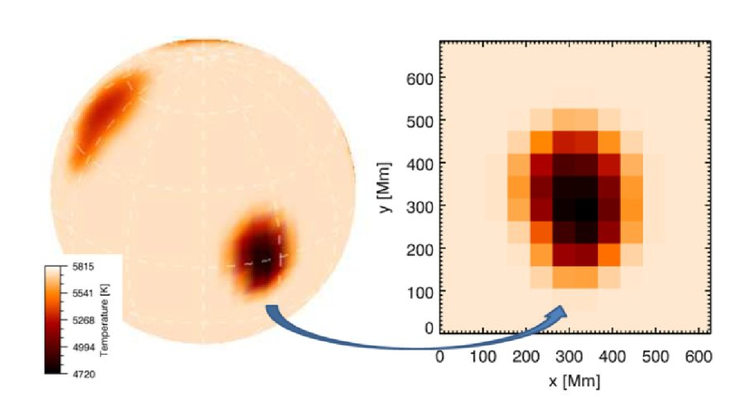
The first temperature surface map of EK Dra from very-high-resolution spectra obtained with the Potsdam Echelle Polarimetric and Spectroscopic Instrument (PEPSI) at the Large Binocular Telescope shows four cool spots. The temperature morphology of one of them appears to show so far the best evidence for the existence of a solar-like penumbra for a starspot.
Read more: Järvinen et al. 2018, A&A, 620, 162
KELT-9 b optical Mg I triplet detected
2018-11-08
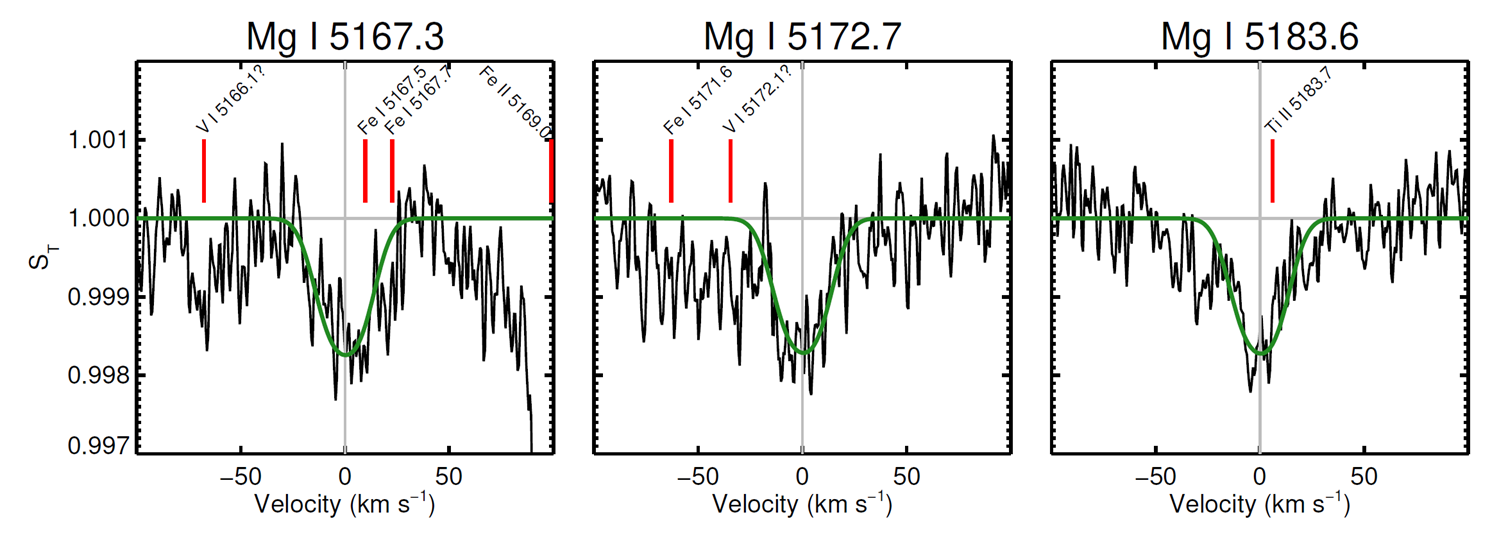
PEPSI has detected the optical Mg I triplet at 7.8-sigma in the extended atmosphere of the ultra-hot Jupiter KELT-9 b. Constraints are placed on the density and radial extent of the excited hydrogen envelope.
Read more: Cauley et al. 2019, AJ, 157, 69
Want a PEPSI? Performance status of the recently commissioned high-resolution spectrograph and polarimeter for the 2x8.4m Large Binocular Telescope
2018-07-01
PEPSI is the new fiber-fed and stabilized "Potsdam Echelle Polarimetric and Spectroscopic Instrument" for the Large Binocular Telescope (LBT). It covers the entire optical wavelength range from 384 to 913 nm in three exposures at resolutions of either R=λ/▵λ=50,000, 130,000 or 250,000. The R=130,000 mode can also be used with two dual-beam Stokes IQUV polarimeters. The 50,000-mode with its 12-pix sampling per resolution element is our "bad seeing" or "faint-object" mode. A robotic solar-disk-integration (SDI) telescope feeds solar light to PEPSI during day time and a 450-m fiber feed from the 1.8m VATT can be used when the LBT is busy otherwise. CCD characterization and a removal procedure for the spatial fixed-pattern noise were the main tasks left from the commissioning phase. Several SDI spectral time series with up to 300 individual spectra per day recovered the well-known solar 5-minute oscillation at a peak of 3 mHz (5.5min) with a disk-integrated radial-velocity amplitude of only 47 cm/s. Spectral atlases for 50 bright benchmark stars including the Sun were recently released to the scientific community, among them the ancient planet- system host Kepler-444. These data combine PEPSI's high spectral resolution of R=250,000 with signal-to-noise ratio (S/N) of many hundreds to even thousands covering the entire optical to near-infrared wavelength range from 384 to 913 nm. Other early science cases were exoplanet transits including TRAPPIST-1, a spectrum of Boyajian's star that revealed strong and structured but stable ISM Na D lines, a spectrum of Oph allowing a redetermination of the ISM Li line doublet, and a first Doppler image of the young solar analog EK Dra that revealed starspots with solar-like penumbrae.
Read more: Strassmeier et al. 2018, SPIE 10702, id. 1070212
Download PDF.
PEPSI wallposters available for download
2018-06-04
The spectra presented in Paper I, II and III are available for download as A0 PEPSI posters. See the Wallposters section among the Data links.