
News
The PEPSI Exoplanet Transit Survey. III: The detection of Fe I, Cr I and Ti I in the atmosphere of MASCARA-1 b through high-resolution emission spectroscopy
2023-04-13
Hot giant planets like MASCARA-1 b are expected to have thermally inverted atmospheres, that makes them perfect laboratory for the atmospheric characterization through high-resolution spectroscopy. Nonetheless, previous attempts of detecting the atmosphere of MASCARA-1 b in transmission have led to negative results. In this paper we aim at the detection of the optical emission spectrum of MASCARA-1 b. We used the high-resolution spectrograph PEPSI to observe MASCARA-1 (spectral type A8) near the secondary eclipse of the planet. We cross-correlated the spectra with synthetic templates computed for several atomic and molecular species. We obtained the detection of FeI, Cr I and Ti I in the atmosphere of MASCARA-1 b with a S/N ~7, 4 and 5 respectively, and confirmed the expected systemic velocity of ~13 km/s and the radial velocity semi-amplitude of MASCARA-1 b of ~200 km/s. The detection of Ti is of particular importance in the context of the recently proposed Ti cold-trapping below a certain planetary equilibrium temperature. We confirm the presence of an the atmosphere around MASCARA-1 b through emission spectroscopy. We conclude that the atmospheric non detection in transmission spectroscopy is due to the high gravity of the planet and/or to the overlap between the planetary track and its Doppler shadow.
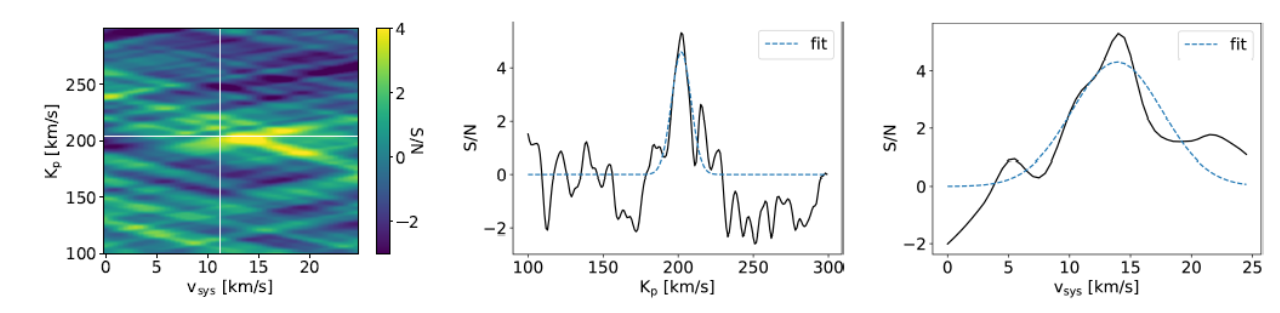
Read more: Scandariato et al. 2023, A&A, 674, A58
The PEPSI Exoplanet Transit Survey (PETS). II. A Deep Search for Thermal Inversion Agents in KELT-20 b/MASCARA-2 b with Emission and Transmission Spectroscopy
2023-02-13
Recent observations have shown that the atmospheres of ultra hot Jupiters (UHJs) commonly possess temperature inversions, where the temperature increases with increasing altitude. Nonetheless, which opacity sources are responsible for the presence of these inversions remains largely observationally unconstrained. We used LBT/PEPSI to observe the atmosphere of the UHJ KELT-20 b in both transmission and emission in order to search for molecular agents which could be responsible for the temperature inversion. We validate our methodology by confirming previous detections of Fe I in emission at 16.9 σ. Our search for the inversion agents TiO, VO, FeH, and CaH results in nondetections. Using injection-recovery testing we set 4σ upper limits upon the volume mixing ratios for these constituents as low as ∼1×10⁻⁹ for TiO. For TiO, VO, and CaH, our limits are much lower than expectations from an equilibrium chemical model, while we cannot set constraining limits on FeH with our data. We thus rule out TiO and CaH as the source of the temperature inversion in KELT-20 b, and VO only if the line lists are sufficiently accurate.
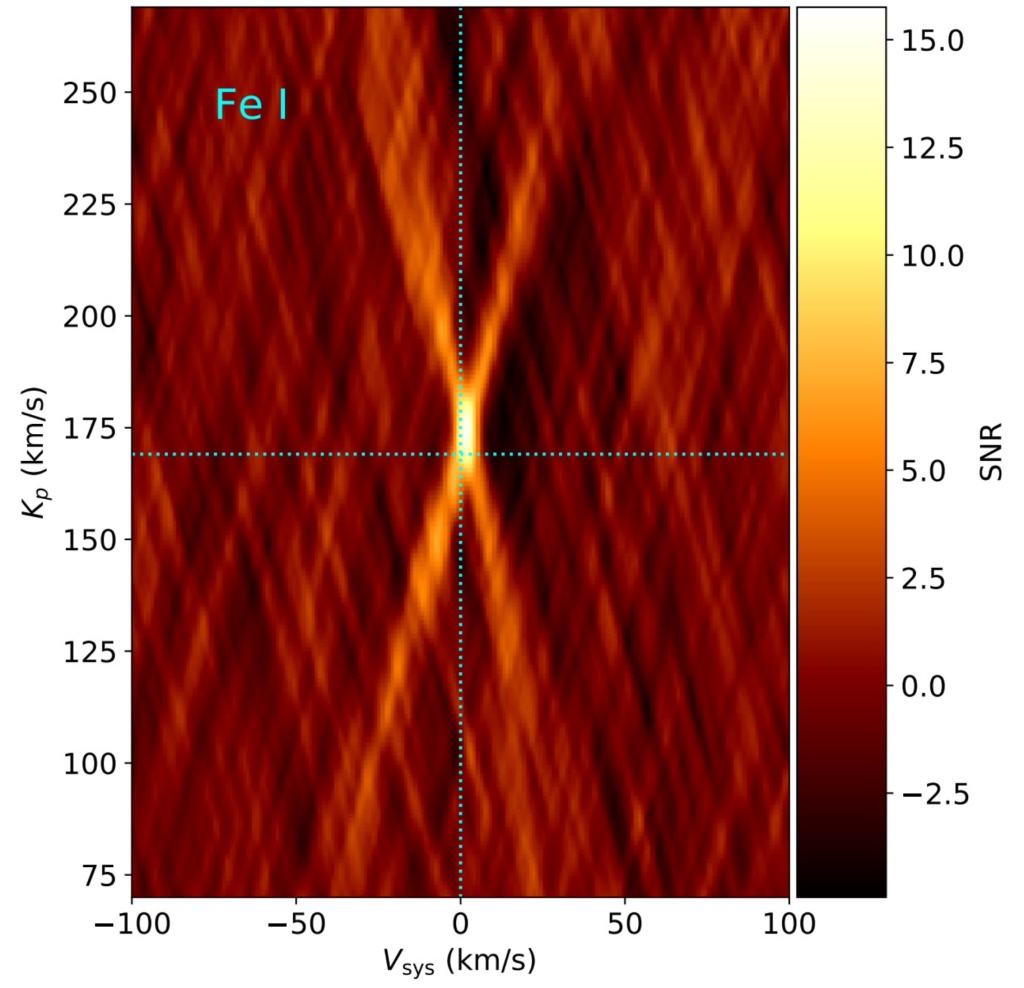
Read more: Johnson et al. 2023, AJ, 165, 157
VPNEP: Detailed characterization of TESS targets around the Northern Ecliptic Pole
2023-02-13
We embarked on a high-resolution optical spectroscopic survey of bright Transiting Exoplanet Survey Satellite (TESS) stars around the Northern Ecliptic Pole (NEP), dubbed the Vatican-Potsdam-NEP (VPNEP) survey. Our NEP coverage comprises 1067 stars, of which 352 are bona fide dwarf stars and 715 are giant stars, all cooler than spectral type F0 and brighter than V=8.5. Our aim is to characterize these stars for the benefit of future studies in the community. We analyzed the spectra via comparisons with synthetic spectra. Particular line profiles were analyzed by means of eigen-profiles, equivalent widths, and relative emission-line fluxes (when applicable). Two R=200 000 spectra were obtained for each of the dwarf stars with the Vatican Advanced Technology Telescope (VATT) and the Potsdam Echelle Polarimetric and Spectroscopic Instrument (PEPSI), with typically three R=55 000 spectra obtained for the giant stars with STELLA and the STELLA Echelle Spectrograph (SES). Combined with V-band magnitudes, Gaia eDR3 parallaxes, and isochrones from the Padova and Trieste Stellar Evolutionary Code, the spectra can be used to obtain radial velocities, effective temperatures, gravities, rotational and turbulence broadenings, stellar masses and ages, and abundances for 27 chemical elements, as well as isotope ratios for lithium and carbon, line bisector spans, convective blue-shifts (when feasible), and levels of magnetic activity from Halpha, Hbeta, and the Ca II infrared triplet. In this initial paper, we discuss our analysis tools and biases, presenting our first results from a pilot sub-sample of 54 stars (27 bona-fide dwarf stars observed with VATT+PEPSI and 27 bona-fide giant stars observed with STELLA+SES) and making all reduced spectra available to the community.
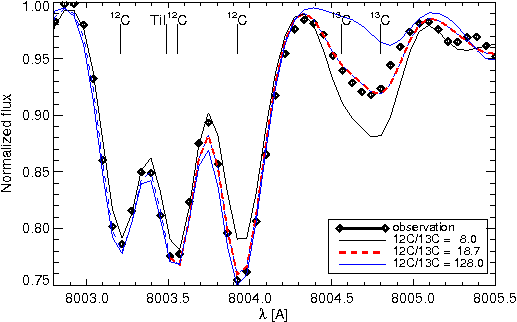
Read more: Strassmeier et al. 2023, A&A, 671, A7
Press release: To new worlds with quantitative spectroscopy
Untangling the Sources of Abundance Dispersion in Low-Metallicity Stars
2022-12-12
We measured abundances of 12 elements (Na, Mg, Si, Ca, Sc, Ti, V, Cr, Mn, Fe, Co, Ni) in a sample of 86 metal-poor subgiant stars in the solar neighborhood. Abundances are derived from high-resolution spectra taken with the Potsdam Echelle Polarimetric and Spectroscopic Instrument on the Large Binocular Telescope, modeled using iSpec and MOOG. By carefully quantifying the impact of photon-noise (< 0.05 dex for all elements) we robustly measure the intrinsic scatter of abundance ratios. At fixed [Fe/H] the RMS intrinsic scatter in [X/Fe] ranges from 0.04 dex (Cr) to 0.16 dex (Na), with a median of 0.08 dex. Scatter in [X/Mg] is similar, and accounting for [alpha/Fe] only reduces the overall scatter moderately. We consider several possible origins of the intrinsic scatter with particular attention to fluctuations in the relative enrichment by core-collapse supernovae (CCSN) and Type Ia supernovae (SNIa) and stochastic sampling of the CCSN progenitor mass distribution. The stochastic sampling scenario provides a good quantitative explanation of our data if the effective number of CCSN contributing to the enrichment of a typical sample star is N approx 50. At the median metallicity of our sample, this interpretation implies that the CCSN ejecta are mixed over a gas mass 10^5 MSun before forming stars. The scatter of elemental abundance ratios is a powerful diagnostic test for simulations of star formation, feedback, and gas mixing in the early phases of the Galaxy.
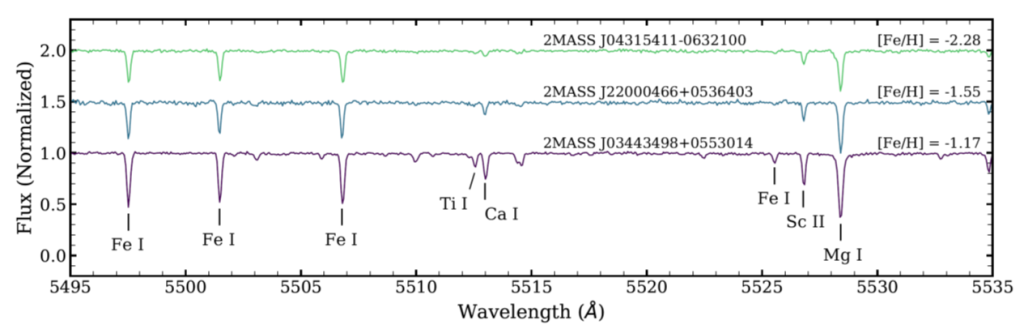
Read more: Griffith et al. 2023, ApJ, 944, 47
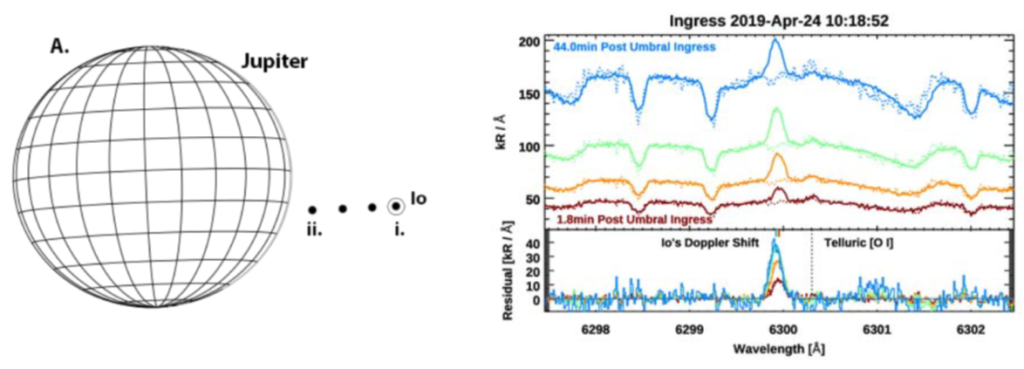
Io’s Optical Aurorae in Jupiter’s Shadow
2022-11-09
Recent studies have established that the majority of Io’s molecular atmosphere, SO2 and SO, condenses during its passage through Jupiter’s shadow. The eclipse response of Io’s atomic atmosphere is less certain, having been characterized solely by ultraviolet aurorae. Here we explore the response of optical aurorae for the first time. We find oxygen to be indifferent to the changing illumination with [O I] brightness merely tracking the plasma density at Io’s position in the torus. In shadow, line ratios confirm sparse SO2 coverage relative to O since their collisions would otherwise quench the emission. Io’s sodium aurora mostly disappears in eclipse and e-folding timescales for decline and recovery differ sharply: ~10 minutes at ingress and nearly 2 hours at egress. Only ion chemistry can produce such a disparity; Io’s molecular ionosphere is much weaker at egress due to rapid recombination. Auroral emission is also evident from potassium, confirming K as the major source of far red emissions seen in situ. In all cases, direct electron impact on atomic gas is sufficient to explain the brightness without invoking significant dissociative excitation of molecules. The non-response of O and rapid depletion of Na during Io’s eclipse phase is surprisingly inverted from the eclipse phase behavior of the SO2 and NaCl parent molecules.
Read more: Schmidt et al. 2022, PSJ, 4, 36