
News
First Doppler image and starspot-corrected orbit for lambda Andromedae
2025-03-16
Starspots on a rotating stellar surface impact the measured radial velocities and thereby limit the determination of precise orbital elements as well as astrophysical stellar parameters and even jeopardize the detection and characterization of (exo)planets. Phase-resolved high resolution optical spectra from PEPSI and STELLA were recorded over the course of 522 days in 2021-2022. Doppler imaging is used to reconstruct λ And’s starspots with very high resolution (R = 250 000) and high signal-to-noise ratio PEPSI spectra. The Doppler image reconstructs a dominating cool spot with an umbral temperature difference of ≈1000K with respect to the photosphere of 4660K and is likely surrounded by a moat-like velocity field. Three more weaker spots add to the total surface spottedness, which is up to 25% of the visible surface.
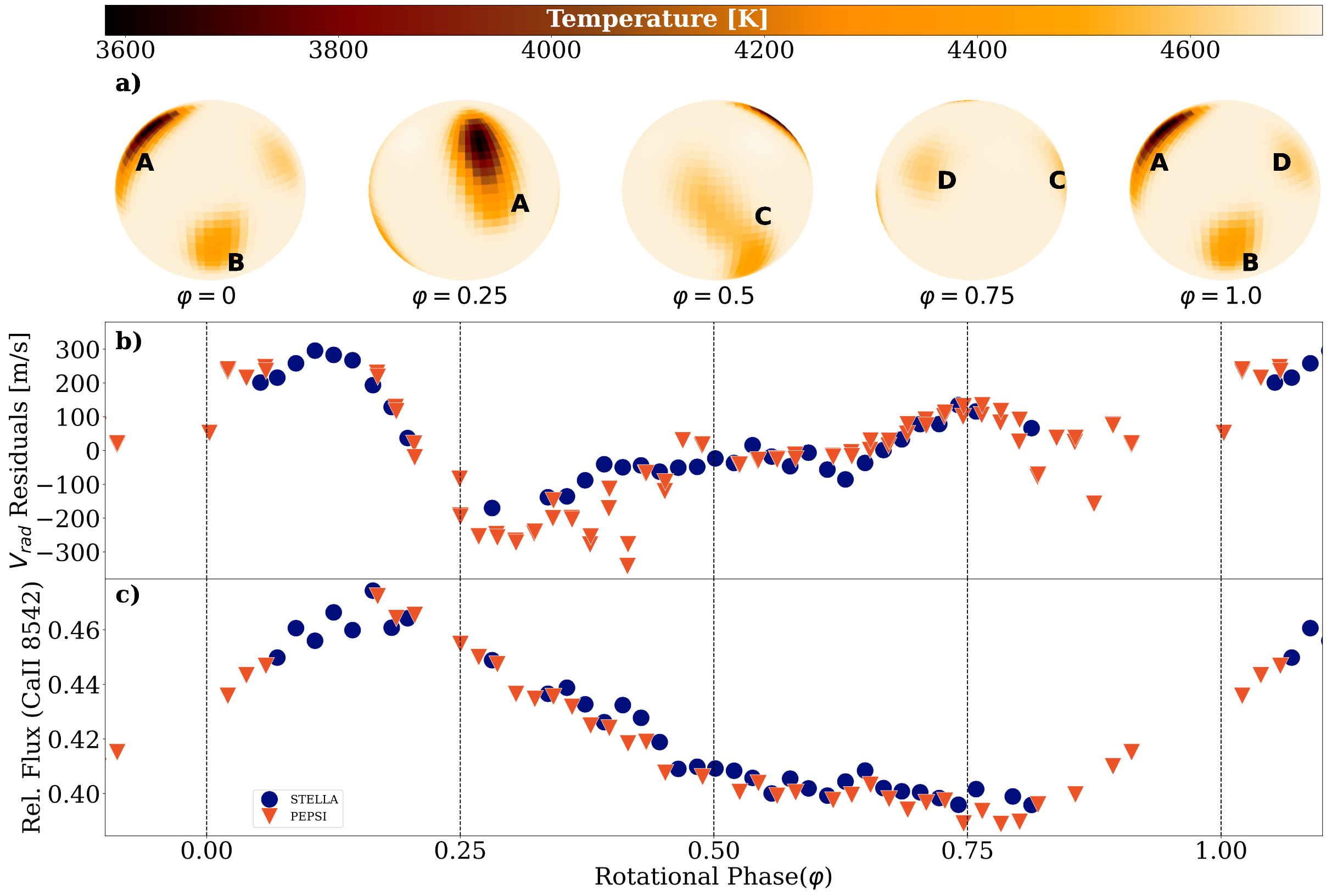
Read more: Adebali et al. 2025, A&A, 695, A89
Testing the Rossby Paradigm: Weakened Magnetic Braking in early K-type Stars
2025-02-10
We present new observational constraints on magnetic braking for an evolutionary sequence of six early K-type stars. To determine the wind braking torque for each of our targets, we combine spectropolarimetric constraints on the large-scale magnetic field, Lyα or X-ray constraints on the mass-loss rate, as well as uniform estimates of the stellar rotation period, mass, and radius. As identified previously from similar observations of hotter stars, we find that the wind braking torque decreases abruptly by more than an order of magnitude at a critical value of the stellar Rossby number. Given that all of the stars in our sample exhibit clear activity cycles, we suggest that weakened magnetic braking may coincide with the operation of a subcritical stellar dynamo.
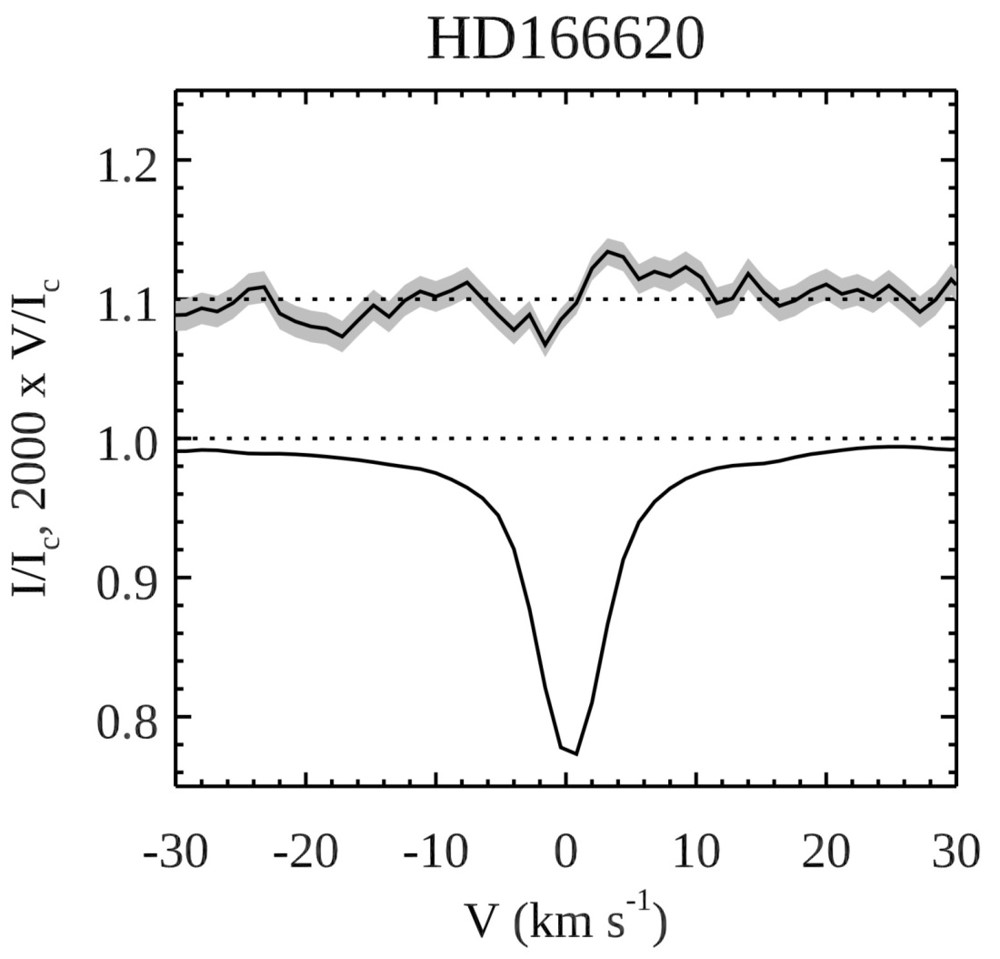
Read more: Metcalfe et al. 2025, ApJ, 986, 120
PEPSI’s non-detection of escaping hydrogen and metal lines adds to the enigma of WASP-12b
2024-11-18
WASP-12b is an ultra-hot Jupiter (UHJ) of special interest for atmospheric studies since it is on an inspiraling orbit in an extreme environment of intense radiation and circumstellar gas. Previously claimed detections of active mass loss from this planet are controversial across the literature. To address this controversy, we obtained two new transit observations of WASP-12 b with the optical high-resolution PEPSI spectrograph on the Large Binocular Telescope. Contrary to previous work, we do not observe planetary H𝛼 absorption and rule out the amplitude of previously reported detections. Our non-detection may be limited by the sensitivity of our data or could indicate weaker mass loss than suggested by previous studies. We conclude that previous claims of H𝛼 absorption from the atmosphere of WASP-12 b should be reevaluated. Given the anticipated line strength of Balmer/optical features, observing the atmosphere of this faint target will require stacking more observations even with the largest telescope facilities available.
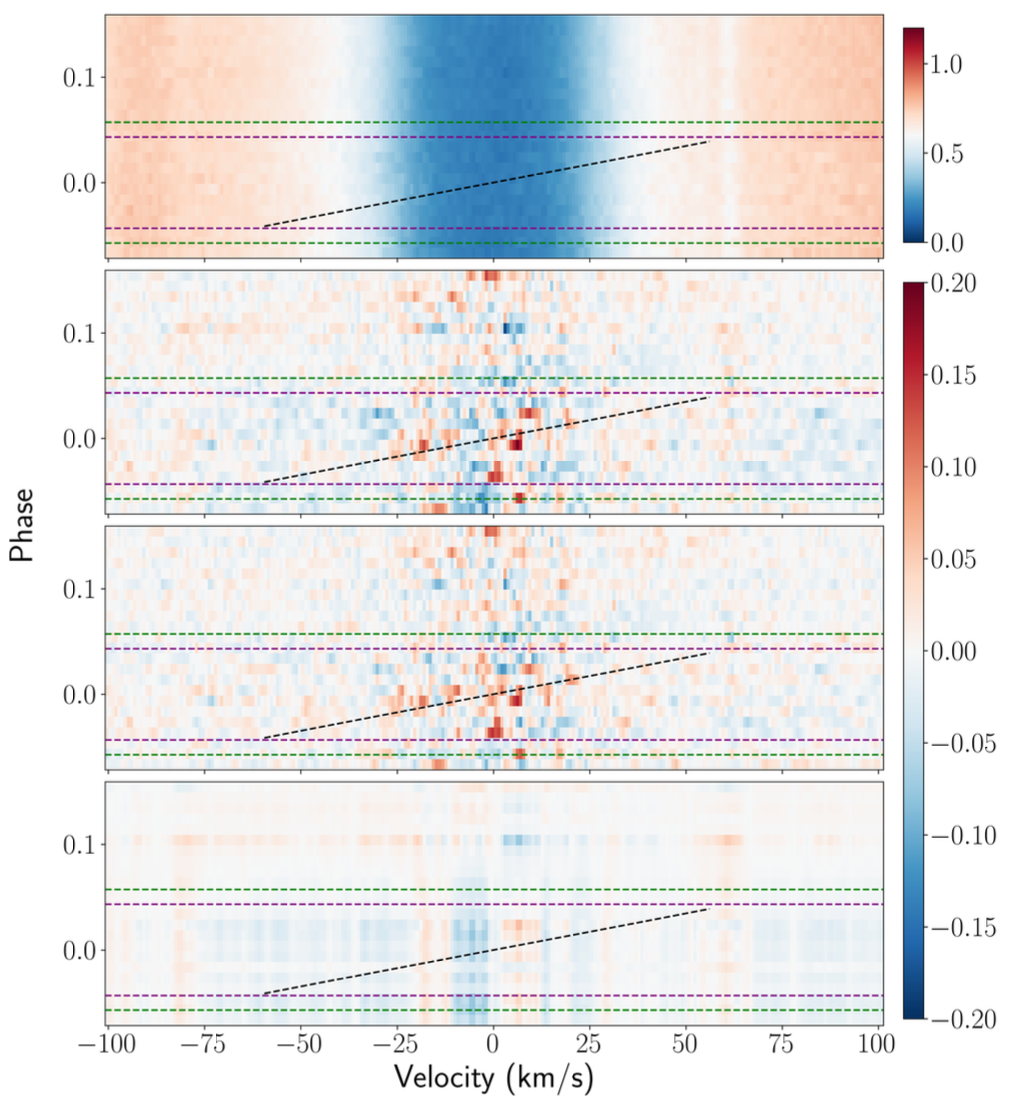
Read more: Pai Asnodkar et al. 2024, MNRAS, 535, 1829
Sun-as-a-Star Spectroscopic Observations of the 2017 August 21 Solar Eclipse
2024-09-18
The solar eclipse of 2017 August 21 was observed with the Potsdam Echelle Polarimetric and Spectroscopic Instrument (PEPSI) on the Large Binocular Telescope (LBT), which is located at Mt. Graham International Observatory (MGIO), Arizona, USA. At this location, a partial eclipse was observed with maximum obscuration of 61.6%. The 11-millimeter-aperture, binocular Solar Disk-Integrated (SDI) telescope, located on the kitchen balcony of the LBT building, feeds sunlight to PEPSI, which has recorded a total of 116 Sun-as-a-star spectra in the wavelength range of 5300 – 6300 Å, with a spectral resolution R=250,000 and S/N of about 733:1. The temporal evolution of the Fraunhofer Na I D doublet at 5890/5896 Å is analyzed using contrast profiles that illustrate subtle changes in the spectral line, not obvious in the intensity profiles.
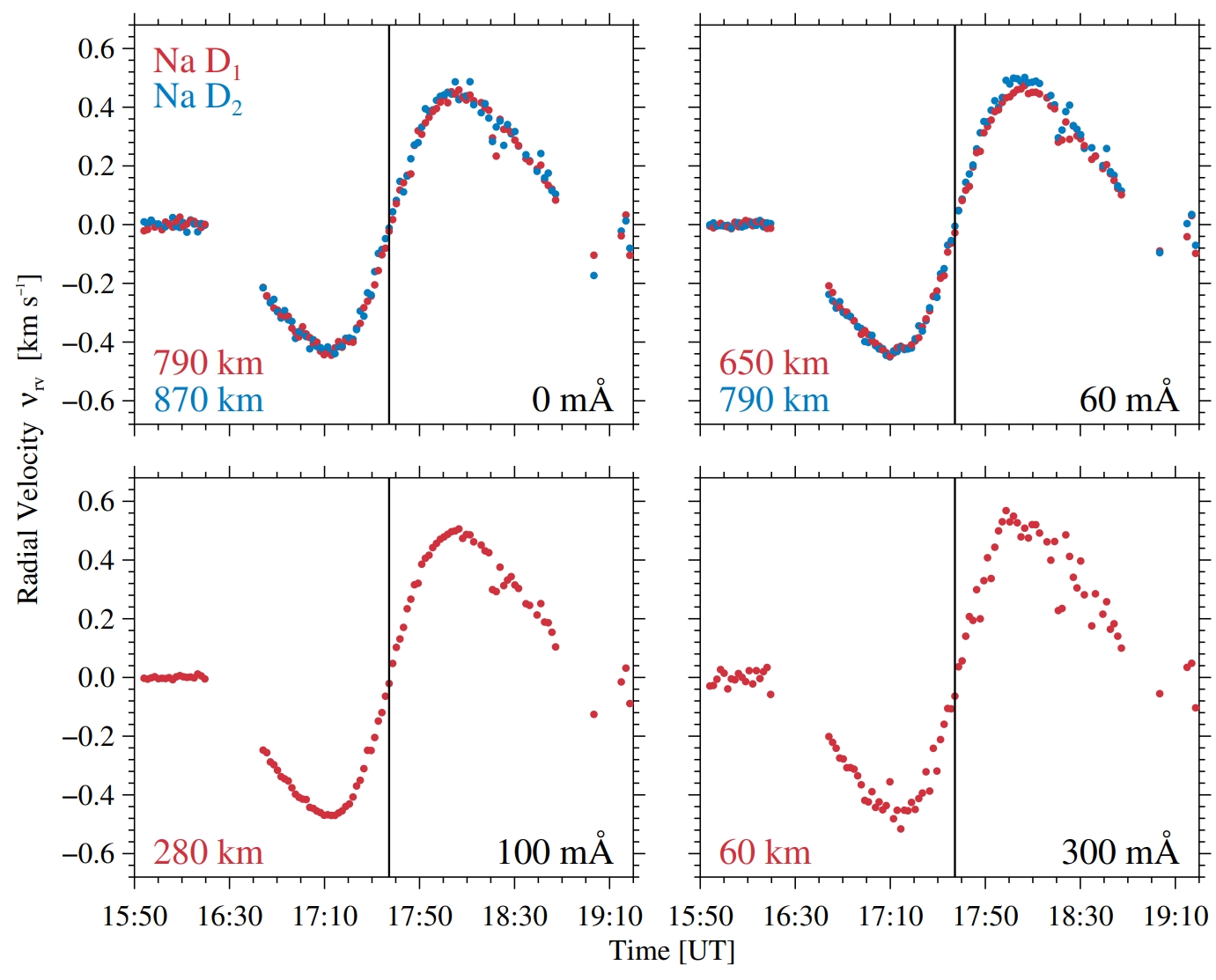
Read more: Dineva et al. 2024, Sol. Phys. 299, 123
Retrieving Young Cloudy L Dwarfs: A Nearby Planetary-mass Companion BD+60 1417B and its Isolated Red Twin W0047
2024-09-16
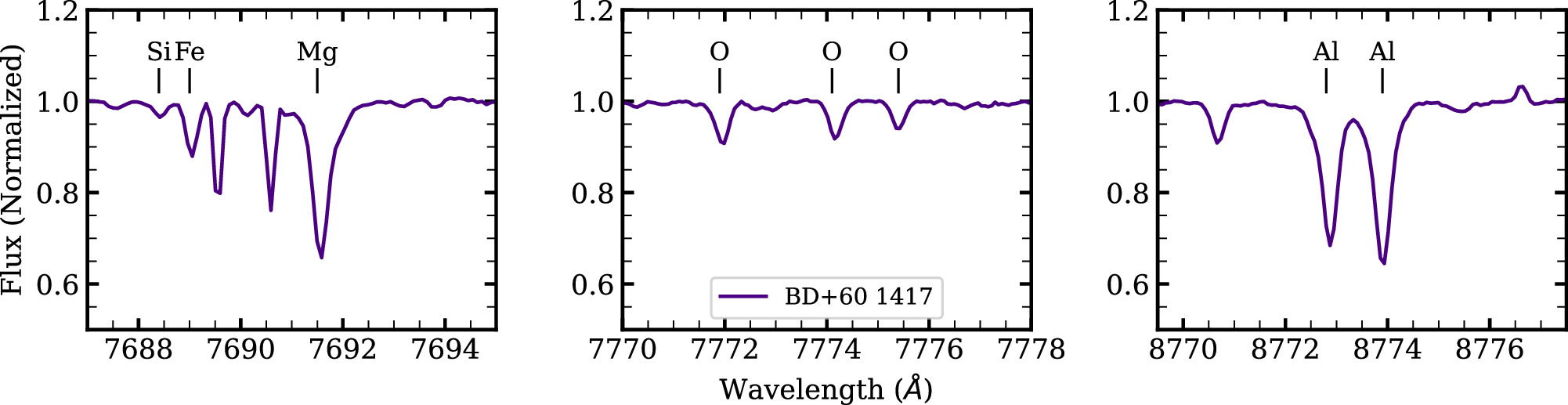
We present an atmospheric retrieval analysis on a set of young, cloudy, red L dwarfs—CWISER J124332.12+600126.2 (BD+60 1417B) and WISEP J004701.06+680352.1 (W0047)—using the Brewster retrieval framework. We also present the first elemental abundance measurements of the young K-dwarf (K0) host star, BD+60 1417, using high-resolution (R = 50,000) spectra taken with the Potsdam Echelle Polarimetric and Spectroscopic Instrument on the Large Binocular Telescope. In the complex cloudy L-dwarf regime the emergence of condensate cloud species complicates retrieval analysis when only near-infrared data are available. We find that for both L dwarfs in this work, despite testing three different thermal profile parameterizations we are unable to constrain reliable abundance measurements and thus the carbon-to-oxygen ratio. While we cannot conclude what the abundances are, we can conclude that the data strongly favor a cloud model over a cloudless model. We note that the difficulty in retrieval constraints persists regardless of the signal-to-noise ratio of the data examined (S/N ∼ 10 for CWISER BD+60 1417B and 40 for WISEP W0047). The results presented in this work provide valuable lessons about retrieving young, low-surface-gravity cloudy L dwarfs. This work provides continued evidence of missing information in models and the crucial need for JWST to guide and inform retrieval analysis in this regime.
Read more: Phillips et al. 2024, ApJ, 972, 172