
We observed the dayside thermal emission spectrum of UHJ HAT-P-70b using the high-resolution spectrographs CARMENES and PEPSI. Through our cross-correlation analysis, we detected emission signals for Al I, AlH, Ca II, Cr I, Fe I, Fe II, Mg I, Mn I, and Ti I, marking the first detection of Al I and AlH in an exoplanetary atmosphere. Tentative signals of C I, Ca I, Na I, NaH, and Ni I were also identified. Based on those detections, we were able to perform atmospheric retrievals to constrain the thermal profile and elemental abundances of the planet’s dayside hemisphere. The retrieved temperature-pressure profile reveals a strong temperature inversion layer. The chemical free retrieval yielded a metallicity of [Fe/H] = 0.38, while the chemical equilibrium retrieval resulted in [Fe/H] = 0.23, with both values consistent with the solar metallicity. We also tentatively found an enriched abundance of Ni, which could result from the accretion of Ni-rich planetesimals during the planet’s formation.
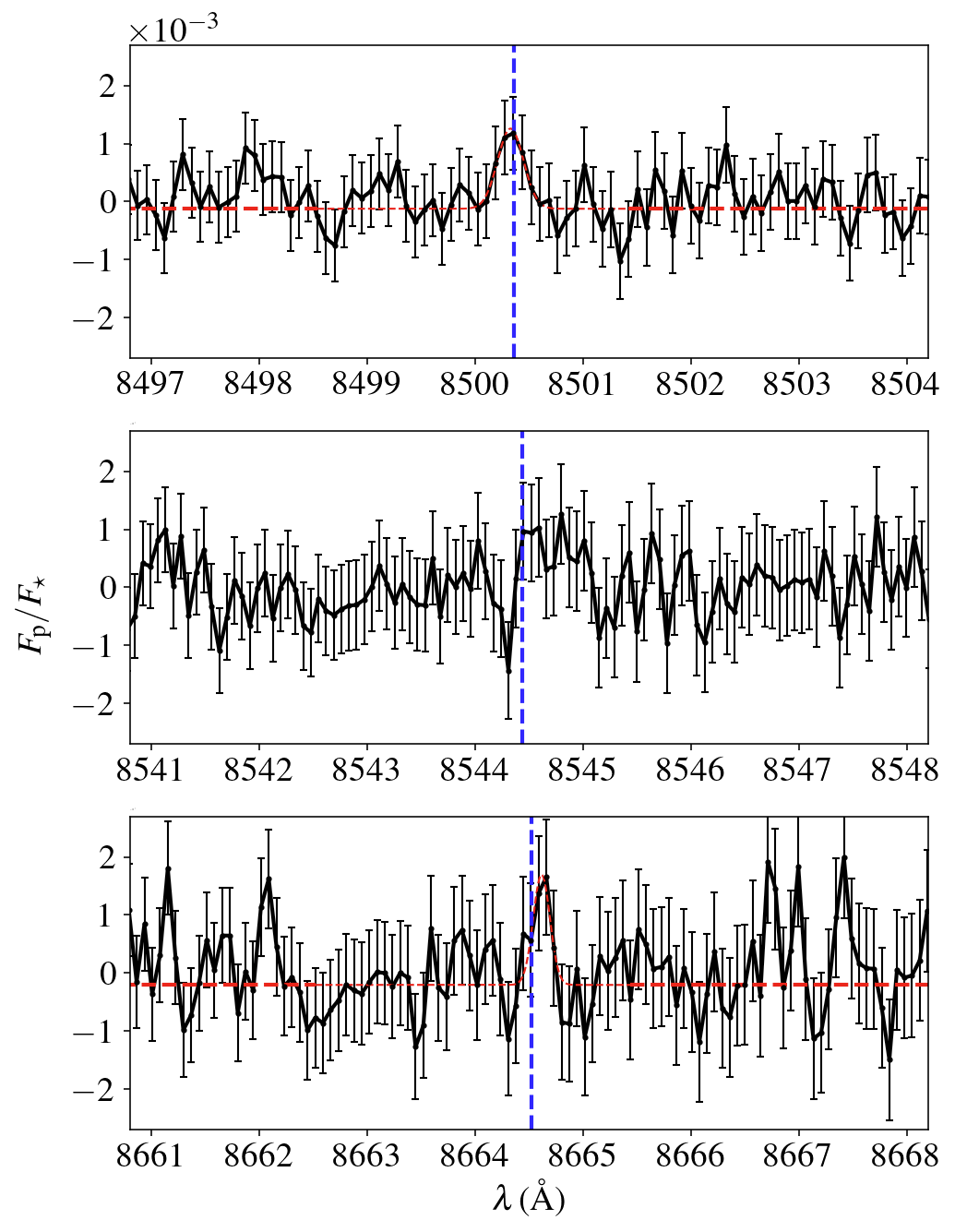
and 8664.52 Å (vacuum wavelengths) were detected, with their
Gaussian fits in red.
Read more: B. Guo, F. Yan, Th. Henning, et al. 2026, A&A, in press. arXiv:2512.21470